Wednesday, July 3, 2013

Le Fanu and Herbert van Thal


I was recently reading Herbert van Thal’s interesting autobiography, The Tops of the Mulberry Trees (1971), which covers many of van Thal’s roles in publishing—as an agent, anthologist, editor and publisher.  Here are a few paragraphs on J. Sheridan Le Fanu:
An author to whom I have always been greatly addicted is Sheridan Le Fanu. It was that remarkable person A.J.A. Symons who first drew my attention to him. I have always been surprised that Le Fanu has never achieved the popularity of his contemporaries, such as Wilkie Collins, though Collins’ reputation rests solely on The Woman in White and The Moonstone, and of whom I am no less of an admirer. Le Fanu is barely known save for Uncle Silas, and some of his short stories from In a Glass Darkly. A. J. A. Symons had a remarkable collection of his works and now that the Sadleir collection is no longer in this country, his works are one of the scarcest to be found. I began collecting his books late in life, and therefore was unable to complete a run of volumes. Those I had I regret now I sold at Sotheby’s in 1964.

Ardizzone's frontispiece to In a Glass Darkly
Peter Davies had the good ides of republishing In a Glass Darkly with illustrations by Edward Ardizzone, but as usual, the result was not so admirable financially. I have always felt that it is a pity that the marriage between illustrator and novelist is no longer popular. I suppose everyone has a preconceived idea in their minds’ eye as to the appearance of the characters in their favoured writings, and prefer not to have this dispelled by an artist’s view. I, however, do not agree with this argument. I always see Alice through Tenniel, Pickwick thought Boz, and I felt similarly Edward Ardizzone completely captured the spirit of Le Fanu, and I only wish that had In a Glass Darkly been a success we could have continued to republish Le Fanu with that artist’s illustrations.

When I had my own publishing house, I naturally wanted to republish Le Fanu, but I only republished one short story from The Purcell PapersA Strange Adventure in the Life of Miss Laura Mildmay.  Montague Summers reproved me for not stating that the story first appears in Cassell’s Magazine Volume IV, 1868, and not in The Purcell Papers. The Le Fanu of Spook Sonatas no loner terrifies—the host, the familiar and the vampire only hold court in the world of the cinema—and in its place something far more realistically horrid is necessary to titillate the flesh of the toughened and permissive young of our time.

The small Le Fanu volume that van Thal published, A Strange Adventure of the Life of Miss Laura Mildmay: A Tale from Chronicles of Golden Friars (London:  Home and van Thal, 1947) included an introductory note by van Thal and a frontispiece by Felix Kelly.  Van Thal also included Le Fanu’s “An Account of Some Strange Disturbances in Aungier Street” in his anthology Great Ghost Stories (London: Weidenfeld & Nicolson, 1960), and introduced a reissue of Le Fanu’s novel, The Cock and the Anchor (London:  Cassell, 1967).  

A sample page-spread from In a Glass Darkly (1929)

Edward Ardizzone contributed over 150 illustrations to the Peter Davies edition of In a Glass Darkly, published in November 1929.  Only six of these are full-page illustration; the rest are smaller vignettes.  All are rather impressionistic ink sketches.  I find I can’t agree with van Thal that Ardizzone is especially desirable as an illustrator for Le Fanu’s writings, nice and atmospheric as those the illustrations may be.

Monday, July 1, 2013

S. T. Joshi’s UNUTTERABLE HORROR and its Reception

S. T. Joshi read an immense amount of material prior to compiling this two-volume history in order to present the most comprehensive study of supernatural literature yet published. He has also organized this material with exemplary care, yet it troubles me that everyone has either lauded this book without noting the extent to which its author's biases compromise the study's integrity, or they have skirted these deficiencies as minor matters that will have little major effect on future critical assessments of supernatural literature.

Even though some reviews have called attention to the overly harsh criticism he doles out to canonical and obscure authors alike, none of the reviews I have read have attempted to address the fallacies and inconsistencies Joshi applies to the works he so readily dismisses. Iconoclasm is such an ingrained part of American culture that we tend to accept the explosion of myths, unseating of sacred cows, and the revelation that the emperor has no clothes without examining whether the iconoclasts have truly opened our eyes to the truth or merely found a new way of distracting us from it.    

I will begin with two quotations from Stefan Dziemianowicz's review, which appeared in the July 2013 issue of Locus.
  
"Unutterable Horror: A History of Supernatural Fiction can be regarded as his ambitious elaboration on Lovecraft’s landmark essay 'Supernatural Horror in Literature'."

Unfortunately, this is one of the major deficiencies of the book. Even though Lovecraft’s letters and a careful comparison of Lovecraft's essay with Edith Birkhead's The Tale of Terror (Constable, 1921)[1], reveal that Lovecraft was not always very familiar with the authors he critiqued, Joshi takes virtually every opinion of Lovecraft's as gospel. Furthermore, if Lovecraft felt an author's work did not meet his standards, Joshi echoes that opinion faithfully, though at greater length.

"Arthur Machen, Algernon Blackwood, M.R. James (all of whom Joshi credits for using their tales of the supernatural as vehicles for expressing their worldviews)" 

Here is one of the key fallacies into which Joshi falls again and again and again, not only in this work, but in its predecessors. When he first wrote about M. R. James in an article later reprinted in The Weird Tale (University of Texas Press, 1990), he dismissed the author as a writer of trifles who lacked the coherent world-view of the other authors in the book, i.e. Bierce, Blackwood, Machen, and Lovecraft. Years later, he has accepted the fact that James does have a world-view, though one he had initially missed, and now acknowledges him as a superior craftsman.  Oddly, as anyone who has read more than a smattering of his work can attest, Blackwood’s fiction does not present a single, coherent worldview, but shifts as his settings and the focus of his individual novels and collections changes. Most of the time his work is pantheist or animist in its concerns, but there are strong traces of a very Christian conception of good and evil in a great many of his works, even though no established church would embrace the way he conceives or presents them.

Joshi tends to award a Weltanschauung to authors with whose views he is in sympathy; but has the unfortunate tendency to deny any legitimate worldview to those writers in whom he sees mirrored elements of traditional religion, even when those views are transformed by such powerful personalities as Joseph Sheridan Le Fanu and Russell Kirk (to name two authors dismissed summarily in this book) or treated in a complex manner that subverts traditional canons of belief, as appears regularly in the work of Le Fanu and Machen.

There is no doubt in my mind that Lovecraft belongs on the very highest tier of weird fiction writers due to the quality of his vision, the conscientiousness with which he shaped his greatest works, and his success in driving his personal vision towards a realization capable of capturing the imagination of people with whom he otherwise had very little in common. Yet, Lovecraft’s vision is not the only vision of horror capable of doing this, since not all of us are atheists, nor materialists, nor is every member of the human race uninterested in the finer workings of the mind or interactions among its fellows. There are important strands of weird fiction Lovecraft failed to appreciate or understand, which predecessors such as James Hogg, Edgar Allan Poe, Joseph Sheridan Le Fanu, Ambrose Bierce, Henry James, M. R. James, Arthur Machen, Algernon Blackwood, Oliver Onions, and many others brought to the fore.  

By setting up Lovecraft as the most appropriate, or in some extreme cases the only legitimate, yardstick with which to measure the human capacity for horror, I believe current scholarship in the field of weird literature risks embracing a fallacy akin to that described by Herbert Butterfield in his famous essay, The Whig Interpretation of History (Norton, 1965). Butterfield warned historians that they risked compromising their work by applying contemporary value judgments against historical figures or events, and assuming that factors we perceive as advantageous to our current condition or favorable to development in any particular field must necessarily be deemed as inevitable and progressive:

"It is part and parcel of the Whig interpretation of history that it studies the past with reference to the present; and though there may be a sense in which this is unobjectionable if its implications are carefully considered, and there may be a sense in which it is inescapable, it has often been an obstruction to historical understanding because it has been taken to mean the study of the past with direct and perpetual reference to the present. Through this system of immediate reference to the present day, historical personages can easily and irresistibly be classed into the men who furthered progress and the men who tried to hinder it; so that a handy rule of thumb exists by which the historian can select and reject, and can make his points of emphasis. (page 11)"

"Our assumptions do not matter if we are conscious that they are assumptions, but the most fallacious thing in the world is to organize our historical knowledge upon an assumption without realizing what we are doing, and then to make inferences from that organization and claim that these are the voice of history. It is at this point that we tend to fall into what I have nicknamed the Whig fallacy. (pp. 23-4)."

Nor is this fallacy peculiar to historical studies, since the most egregious example known to me was responsible for a Serialist hegemony in classical music among publishers, performers, and academics during the first five decades following World War II, during which composers writing tonal music were labeled "useless" and had increasing difficulty having their concert works performed or published. This fallacy thrives on the assumption that a given concept or artifact embraced by a segment of contemporary society (e.g. Democracy, free market economy, serialist music, horror fiction with a  cosmic or materialist basis antagonistic to established religion, mint-flavored toothpaste)[2] is the logical and only legitimate result of sustained development in that sphere.  By accepting these preconceptions, anything that deviates from progression to the desired result must be viewed as wrong, as anything leading up to it is viewed as immature, and anything deviating from it in the present is viewed as flawed, decadent, old-fashioned, wrong-headed, silly, and what-have-you.

Dziemianowicz begins the final paragraph of his review as follows:

Unutterable Horror is a very opinionated historical study, and Joshi’s criticisms are sometimes unnecessarily caustic. But this book is indisputably a work of considerable scholarship. Joshi has done his homework to fill the gaps in the fossil record of supernatural fiction, and the wealth of data with which he provides the reader for primary and secondary sources is invaluable.”
This is a just appraisal of all the work Joshi has put into this study. The crucial sentences, however, appear in the final two lines:  

“Invariably, readers will seek out many of the works cited in its two volumes to render their own critical estimates. Present and future scholars will undoubtedly treat this book as one that establishes the critical standard for evaluating supernatural fiction.”

I cannot express strongly enough my desire that the final sentence of Dziemianowicz’s review be yoked indissolubly with, and tempered by, that which precedes it.  All too often, the opinion of one authority is deemed sufficient reason for any reader, perennially as short of time as he or she may be of funds, to forego the opportunity of investigating an author on their own.  Joshi may have established a “critical standard for evaluating supernatural fiction” in this book, but that does not mean that his assessments are always either just or unassailable.  Herbert A. Wise & Phyllis Fraser Cerf dismissed “hundreds and hundreds of stories” as “commonplace” or “sheer trash” in the “Introduction to the Notes” to their benchmark Great Tales of Terror and the Supernatural (Random House, 1944). Nearly seventy years later, and without knowing specifically which works they omitted, their criteria for inclusion seem reasonable. In Joshi’s case, the exclusions are named, and the criteria again seem reasonable, as stated, even though the way Joshi applies these criteria does not always seem reasonable or equitable. It is up to us who do not share Mr. Joshi’s particular set of biases (admittedly due to biases of our own, which can be overcome or placed into context via a community of readers and scholars in this field) to ensure that a perspective is maintained that allows for appreciation of the full panoply and richness of supernatural literature.  


[1] A work from which "Supernatural Horror" borrows more than is usually acknowledged.
[2] Efforts to market dental hygiene in Asia were rewarded when it was realized that Green Tea was accepted as a more palatable dentifrice in China than the mint or fruit flavors favored in the West.

Monday, May 27, 2013

Le Visage Vert issue no. 21

My apologies for the late notice, but I do want to spread the news that issue number 21 of Le Visage Vert came out late last year. As always, it's a beautiful production. Writers represented range from the older John Bedoit (1829-1870), Lafcadio Hearn (1850-1904), Marcel Schwob (1867-1905), Richard Marsh (1857-1915), and Bodo Wildberg (1862-1942), to the contemporary Nicholas Royle (b. 1963). The Hearn story is from Kwaidan. The Schwob story is from The King in the Golden Mask.  Richard Marsh's tale, "The Mask", includes illustrations from its appearance in The Gentleman's Magazine, December 1892 (the story was later collected in Marvels and Mysteries). Nicholas Royle's story, "The Lure", is translated from it's appearance in The End of the Line: An Anthology of Underground Horror (2010), edited by Jonathan Oliver. Michel Meurger contributes a long essay "Le Secret du masque", setting up the major theme for the issue. To order, visit this website and scroll down to find the issues of Le Visage Vert. Recommended. 

Wednesday, May 15, 2013

Rex Ryan addendum

Further to the post below, Rex Ryan's granddaughter, Elspeth Caton, discovered the following fascinating newspaper article, probably from the Fleetwood Chronicle.  The date is uncertain, but judging from the evidence of other articles in the clipping, it appears to date to about May 1926.

The relevant section of the article reads: "Next week the company [The Fleetwood Palace Stock Co.] will present "David Garrick." The rare comedy of this famous play should endear it to every patron of "Our home of drama." The production will witness the return to Fleetwood of Rex Ryan, who will be remembered as a member of last year's dramatic company. Mr Ryan will be the David Garrick, as well as the producer of the play. He has had a unique experience in repertory of every kind, including all Shakespeare's plays. He is himself an author, not only of many successful plays, but of two or three novels of which the best known is "The Tyranny of Virtue," a best-seller in Australia and by no means unknown in this country."

So it appears there are still a couple of Rex Ryan novels to be found.  Kudos to the first person to discover these books!

A note of caution, though - I'm not sure that The Tyranny of Virtue was a bestseller in Australia - there are only two references to it in the NLA's digitised Australian newspapers - for the copies sent to The Sydney Morning Herald and the Melbourne Argus. And no copy exists at any library in the UK, which might suggest it is unknown in this country!


Tuesday, May 14, 2013

Rex Ryan/ R.R. Ryan

A useful resource I wasn't aware of until today is The Stage Archive, with searchable digitised images of the long running theatrical advertiser, The Stage Directory.  Unfortunately it's not free to use, and the search engine isn't necessarily accurate in picking up names, however there is a wealth of material including some references to Rex Ryan, better known as the cult 1930s thriller writer, R.R. Ryan.  Using the Stage Archive it is possible to trace  the activities of Ryan and his wife, Anne, who used the stage name Pauline Duke.

The first reference I could track was an advertisement dated 29 October 1925: "Wanted to let, unproduced farce, small cast, simple scenery. One big scream. Suit St. Char. Com. - Ryan, 78, Clarendon Rd, C.-on-M., Manchester."

Next is an advertisement from 5 November 1925, which confirms their address in Manchester:
Unexpectedly disengaged and looking for work. Perhaps to save a few pennies they refer to themselves as R.R. and P.D. A similar advertisement with the same address appears in the next issue, dated 12 November 1925.

The next reference is dated 8 July 1926 and refers to a play of Mary Roberts Rinehart's, The Bat, put on by Stephen C. Venner's Venner Repertory Co. at the Rotherham Repertory. According to the reviewer "The audience liked, too, the acting of Mr Rex Ryan as Dr Wells." On 2 December 1926 at the same venue, the Venner Repertory Co opened with "If Winter Comes" and Rex Ryan was one of the principals.

The following year, Rex Ryan and Pauline Duke started their own company, the Imperial Players.  They were advertising for small-part actors and a stage carpenter in July 1927. (Interestingly,  in October 1930, The Stage describes the court case of a stage carpenter named William Lawrence Thompson. Amongst his other offences is the following: "For a short time in 1928 Thompson was employed as a stage carpenter by a Miss Pauline Duke, of Kidderminster. In August, 1928, he was given instructions by Miss Duke to take care of scenery, and was handed sums of money to pay for haulage and the company's railway fares to Rugby. He adsconded with both amounts, and also stole gramophone records valued at 7 pounds, the property of Miss Duke.")

On 8 December 1927 the Imperial Players presented "Lady Windermere's Fan" at the Royal at Castleford (which was managed by Ryan's former colleague at Venner's Repertory Co, Rex R. Stewart), with Rex Ryan playing Lord Windermere.  The review says that "The Mad Doctor" will be presented tonight."  One week later the Imperial Players presented "Ashes of Virtue" at the Royal.  The reviewer notes that "Rex Ryan gave an excellent characterisation of the Jew," and goes on to say that "Pauline Duke was charming as Peace Meredith." The review goes on to say that "The Black Triangle" will be presented during the week.  On 22 December, also at the Royal, the Imperial Players put on "The Mystery of Mrs Drew," with Pauline Duke in the title role.

Early in 1928 the Imperial Players are at the Royal in Worthing, near Brighton, where Ryan seems to have been manager.  He advertises for players in April, with rehearsals on 24 April. The address for prospective players is Manager, 28 Grafton Rd, Worthing.

On 12 July 1928 the Imperial Players presented "The Volga Boatman" at the Royal and Empire in Peterborough, with Rex Ryan as the Boatman and Pauline Duke as Princess Paula.  On 19 July they played at the Alexandra in Pontefract, with Ryan giving "an excellent representation of Carol, the boatman," and Pauline Duke playing Princess Paula "with dignity." On 9 August they were at the Kidderminster Opera House and on 30 August at the Royal at Bilston.

On 4 October 1928 they are advertising for players again, this time the contact is DUKE, 3 Willow Cottages, West St, Brighton. This was the address of Zoe Elsworthy (ie Mrs Adderley Howard), the mother of Pauline Duke (ie Anne Ryan), who passed away at that address on 18 March 1936.

However, on 2 May 1929 the follow advertisement appeared: "Wanted to sell.  All the successes of the recently disbanded Imperial Players. 'The Volga Boatman.' Refer Barnsley, Worthing, Percy B. Broadhead, Bognor, Peterborough, Lincoln, Doncaster, Rugby, Lidderminster, W.H. Glaze, Scunthorpe, S.C. Venner etc etc. An entire repertoire of real money-makers for a song: 'The Black Triangle,' 'A Cry in the Night,' 'The Demon,' 'Ashes of Virtue,' 'Mystery of Two-Gun Jules,' 'The Trap,' 'The Capital Change." Anyone interested is asked to write to the AUTHOR, 96 Victoria St., Fleetwood, Lancashire.

On 8 August 1929, Rex Ryan's own play, "The Mandarin Wong Koo" (licensed as "Yellow Vengeance") was presented at the Palace in Trent Bridge and reviewed in The Stage:


 The review goes on to say that "Mr Atholl-Douglas gave a fine impersonation of the Mandarin Wong Koo, observing throughout an impressive restraint. Mr J. Templar Ellis supplied a contrast with a telling embodiment of the frenzied Pearson, whose distraught state was graphically portrayed. Miss Maureen O'Mara sounded the emotional note with skill and judgment as Miriam, and Mr Noel Mackintosh supplied acceptable comic relief to the tension by his good-humoured rendering of the role of Dr James. Mr R. Clifford Holmes convincingly indicated the subtlety of Yen Ling with whom Miss Lesley Deane as Grace Lewis played her scene admirably. Miss Lily Adeson was a capital San Ming Lee, and Mr Harold Baker did well as the porter. The piece is crude, but its sensational theme and exciting situations invest it with appeal as an attraction for popular audiences. It had an unmistakably hearty reception."

On 31 October 1929 Rex Ryan is advertising the play, spruiking its obvious virtues:


Again, the contact address is Zoe Elsworthy's.  He must have had some success because The Burnley Times of 24 June 1931 advertises The Mandarin Wong Koo "by Rex Ryan", which is being staged at the Victoria Theatre by the Julian and Ward Players.

In 1930 Rex Ryan and Pauline Duke were in Ireland.  On 12 June the Empire Players present "Heart of a Thief" at the  Empire in Belfast with Rex Ryan and Pauline Duke acting in it. On 17 July the Empire Stock Company presents "Ignorance" at the same venue.  According to the reviewer, "Rex Ryan as the Rev. Frank Hastings is natural in all he does," and "Pauline Duke is a restrained and finished Mary Martin."  In 19 June the pair were performing in "Under Two Flags," the popular Harry Collingwood novel; on 31 July, "Beggers on Horseback," on 14 August, "A Sinner in Paradise," and on 4 September, "When the Man is Away."

By 13 November 1930 they are in Liverpool advertising for once again for work: "Pauline Duke and Rex Ryan. Dis. Leads. General Manmgt. 165, Islington, Liverpool."

From this point I haven't found Rex Ryan mentioned in The Stage, though there may well be references I've missed. Presumably Rex and Anne settled in Brighton and Rex started writing novels.

It's also worth noting a reference on 20 September 1928 to a play called "Stone the Woman!"  The reviewer calls it "a strong, outspoken play based on the novel, "Tyranny of Virtue" by Noel Despard. A good house on Monday greeted the play with enthusiasm."  Rex Ryan is known to have written "Tyranny of Virtue" under the name Noel Despard.

The British Newspaper Archive has a couple of references to "Stone the Woman!" - the Derby Daily Telegraph of 11 August 1926 says "Mr Alfred Denville has secured the rights to "Stone the Woman!" by Noel Despard from Mr Leonard Harrison who produced and toured the piece. Mr Harrison, I believe is part author of the play in addition."  It is worth noting that Harrison ran a repertory company with Stephen C. Venner from 1924 to January 1925 - as we have seen, in 1926 Rex Ryan was one of the principals in Venner's repertory company.

There is also an advertisement for the play, showing at the Grand Theatre, Plymouth, in The Western Morning and Mercury dated 14 April 1927, "by Noel Despard, author of the daring novel The Tyranny of Virtue."

Friday, May 10, 2013

R.I.P. - Roger Dobson, author and bookman


I am sorry to report the very sad news that Roger Alan Dobson, author, journalist and bookman of Oxford, has died. He was the co-editor, with me, of several booklets about Arthur Machen, of Aklo, the journal of the fantastic, and The Lost Club Journal (devoted to neglected writers). He also wrote radio plays, including a successful BBC Radio 4 production about the Kingdom of Redonda, the Caribbean literary realm associated with M.P. Shiel and John Gawsworth, which fascinated him: in recognition of his work here, Spanish novelist Javier Marias ennobled him in his Redondan court as the Duke of Bridaespuela .

Roger was proud of his Manchester upbringing, and wrote a study of Ann Lee, the Manchester Messiah, about a local prophetess. He was a regular contributor to the Antiquarian Book Monthly Review (ABMR) on recondite literary subjects, including one article which made out the case that Sherlock Holmes must have gone to a Manchester college. This exhibited the sense of mischief Roger often brought to bookish matters: he was also implicated, with his friend the bookseller Rupert Cook, in the letters and writings of the hoax poet (who showed signs of coming alive), C.W. Blubberhouse. He also contributed lively and learned material to Colin Langeveld's Doppelganger Broadsheet, sometimes as the querulous 'Professor Herbert Trufflehunter'.

I came to know Roger in the early Nineteen Eighties when I was told he was an enthusiast of Arthur Machen, whose work I discovered at the age of seventeen. This proved to be a considerable under-statement. Roger knew more about Machen than anyone else I ever met, and between us we started a modest campaign to revive interest in him, which was at a low ebb in the early Eighties. We met or corresponded with many who had known Machen, including his son Hilary and daughter Janet, and close friends such as Colin Summerford and Oliver Stonor: in time, we found others who were intent on celebrating him, leading to the Machen societies, journals and other publications since. Roger wrote the Machen entry in the Dictionary of National Biography, after rightly arguing for his inclusion: edited John Gawsworth's biography of Machen; co-edited Machen's Selected Letters (with Godfrey Brangham and R.A. Gilbert, 1988); and contributed to Faunus, the journal of the Friends of Arthur Machen, with illuminating essays on Machen mysteries. A checklist of his writings is in preparation.

But Machen was far from Roger’s only literary interest: he was immensely well-read, and talked charmingly and with infectious enthusiasm about many other, especially semi-forgotten, figures. For some years he and I would meet in Oxford, where Roger had a bedsit at 50, St John Street, a former home of Tolkien, and have long talks about books and authors who ought to be revived. Roger’s special passion after Machen was George Gissing, whom I then did not quite get (I suppose because he was insufficiently ‘like’ Machen): but he insisted on the wonder of The Private Papers of Henry Ryecroft, and I have recently come to see why: how I wish I could tell him.

Roger had been a journalist in Manchester and Bristol, and still occasionally did freelance work, but (like Machen) he came to dislike this, and preferred to write on literary themes. However, he never lost the journalistic knack of knocking on doors to elicit information, when he wanted to pursue a writer’s homes and haunts, which included Machen’s house in the Chilterns (then owned, to Roger’s delight, by a gentleman with the Welsh kingly name of Cadwallader); and the grave of the alchemist Thomas Vaughan in an obscure Oxford village (“the graveyard plan is on the back of a cornflakes packet”, the sexton told us).

Roger was a very private man: though I was among his closest friends in those Machenstruck days, I never learnt very much about him, except his bookish enthusiasms. He was devoted to literature and, as with Machen and Gissing, it seldom rewarded him materially: but it gave him rarer things; the joys of scholarship, shared discoveries, and the stubborn integrity of a proud spirit.


Mark Valentine


Below: Roger Dobson (right), with other Machen friends, striding off down the old lane from Llanddewi Fach to Llanfrechfa, a favourite walk of Machen's (photographs: Iain Smith).


Sunday, May 5, 2013

Rain Instruments

“Quaint, but strangely beautiful…”
(Rosemary Pardoe, editor of Ghosts & Scholars, on Rain Instruments)

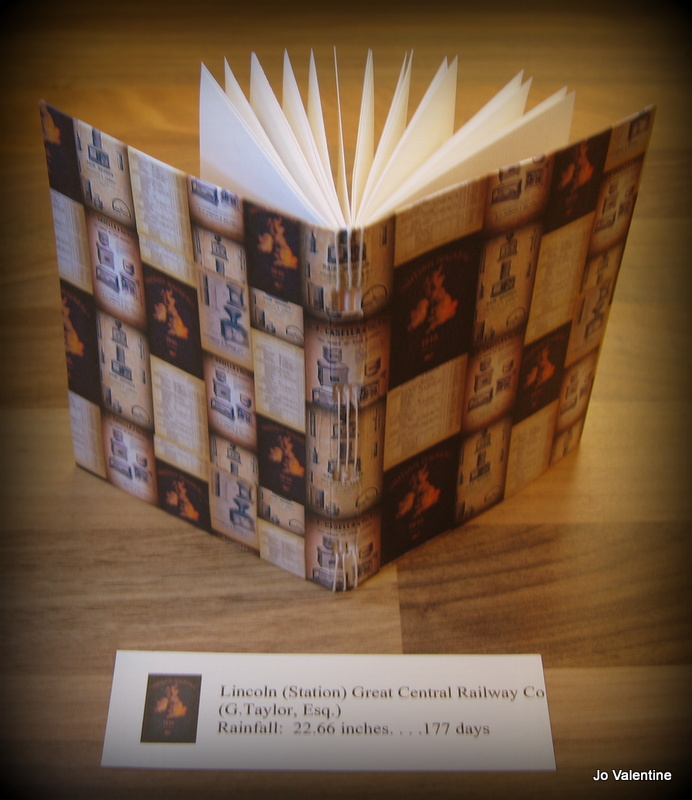
Rain Instruments is a book of found poems created by Mark Valentine from an Edwardian weather survey (British Rainfall 1910), recalling a lost time of country house amateurs in whimsical pursuit of a typically British preoccupation: rain measurement. Here is a selection of poignant, stoical, strange and surprising phrases selected and arranged to form a new work that readers have found “poetic,“intriguing”,“fascinating” and even “exciting”.

Jo Valentine’s design for this palm-of-the-hand volume features a mosaic of images taken from the original rainfall book, and it is made using a traditional long stitch binding. Each copy, in a limited hand-made edition of 25, comes with a bookmark showing an individual rain gauge reading from the survey: it might be from Miss Usborne at The House, Writtle; from Mrs Story Maskelyne at Basset Down House; from the gauge of Captain Ching, R.N. of Launceston; or from another of the keen individuals and institutions that sent in their records.


Note - Rain Instruments has previously been published in a limited electronic edition only. This is the first book publication, slightly revised.

Update - all copies have now been taken. A new title will be announced when ready.

Saturday, April 20, 2013

Rare Sidney Sime frontispiece to T.E. Ellis's CHILDREN OF DON (1912)

Just a quick post to share the rare Sidney Sime frontispiece to T. E. Ellis's Children of Don (London: Edward Arnold, 1912), a book which I have reviewed in my "Late Reviews" column in Wormwood no. 20 (Spring 2013), just published. Not all copies of this volume contain the photogravure frontispiece, a characteristic Sime illustration, here depicting a scene from the prologue, where Gwydion seizes the cauldron of Caridwen (click on the illustration to make it larger):

I am alone with the old gods; there breathes
About me menace of dire things to come.
Great beings watch, and a low distant drum
Thunders for change.
                               [Gwydion takes up the cauldron.
                                   I make this mine.
What flood I loose of powers obscure, divine,
What nest I rouse of venomed ills that bask,
Be to my charge. For here I hold
The fortune and the torment of my race.
Here I set destiny, a deathless rite
Upon the working of my kind: a geis
Upon these isles for ever. Mark!
Mark it, ye ancient ones, whom the great cold
And barren regions bind and mask.
I, Gwydion, take on me the stark
And dangerous deed, all that you ask,
Bare breast to lancing lights and bold
Acceptance of the darkness that you rule. 

The collaboration between the artist S. H. Sime, the poet/librettist T. E. Ellis (Lord Howard de Walden), and the composer Joseph Holbrooke, is fascinating, and I am continuing to delve further into their association.