Sunday, July 29, 2018

In That Look the Unicorn Stood & Other Dreamt Books


"People do tell their dreams," said Arthur Machen, in conversation with Morchard Bishop, "but . . ." and there was a world of doubt in that 'but'. But undaunted by that very judicious 'but', this post is about dreams of books, by which I mean not daytime longings for great rarities or lost volumes, but unknown works encountered in sleep.

For I occasionally dream of finding books that do not seem to exist (yet), and sometimes remember their titles. In a way, this is hardly surprising given the amount of time I spend in bookshops, and reading, or writing about books. The titles are usually quite authentic-sounding: for example, I once found in a dream a slim volume called My Cricket by Lord Dunsany, a book he never wrote, alas; but he did write the short story ‘Autumn Cricket’, and a book called My Ireland, so one can see how my imagination might have combined the two. But others are not quite so obviously explained. Here's some notes on others I have dreamt.

7 September 2008

I handled a small piece of pale turned wood which had a lid which delicately screwed off. Inside was the impress of a device used to make a mark upon paper. I learned that this was a “Tuddington chess seal”. The picture it made would represent, heraldically, a chess piece, which would be used in some way to play the game over a distance. I knew that I was dreaming and that I had to remember the name of this artefact. At a later stage, I was in a temporary structure at the end of a street, which was selling books for a pound each. I only found one I wanted, Further Essays by Sir Francis Younghusband, and I wrote “Tuddington chess seals” on the rear blank endpaper in pencil. But then I remembered this was also a dream, so I still hadn’t ensured I would remember it. Meanwhile, I was distracted by someone else buying a fine illustrated book on The Basilisk, which I knew was worth much more than a £1.

1 November 2009
I was at a book auction. I had not registered to bid but as I looked at the catalogue I saw books I should certainly want. It seemed too late, but as the ceremonials went on, I darted down to the office, run by a couple of practical old ladies. I was permitted to register without even giving full particulars. One book I especially wanted was an early study or memoir of Percy Pilcher, the aviation pioneer who was killed at Stanford Park, on the Northants/Leics border: there is an obelisk memorial to him. The book was Edwardian, with its spine missing, exposing the newspaper lining underneath, and grey boards with crumpled corners: I think there was an inset vignette. I find that Pilcher was a pioneer of gliding rather than powered flight, and the inventor of four different craft, picturesquely named The Bat, The Beetle, The Gull and The Hawk.

18 October 2010
I had discovered a paper-covered monograph written by a colonial district officer on a Pacific island which posited a link between earthquakes and volcanic eruptions. He had discovered this through his own observations of natural upheavals on the island. Though this link was now widely accepted, it had not been known at the time he wrote, making him a scientific pioneer. I was working out how to tell his story and publicise my find.

5 August 2015
I was going through the papers of a progressive public school, in some advisory capacity. These included a school magazine with a piece of highly ornate fantastic fiction, which I noted was in the style of Mervyn Peake, and very accomplished. I thought, I must make a note of the name of the author and follow up to see if they went on writing. The surname was distinctive and would be easy to trace: but I have not remembered it. I have a vague sense of chivalry, medievalism. The surprising thing is that in the dream the page of writing was perfectly clear before me and I was reading it just as I would if awake. If I could have remembered it, I’d have a segment of strange prose.

29 December 2015
I found a copy of Astral Travel in the Edwardian Age, a book which certainly ought to exist, but doesn’t yet (or at least not here). It was an exploration of the work of occultists and visionaries on what they conceived to be the astral plane, with descriptions of their journeys, and quotations from their writing. As soon as I awoke, I remembered the title and wanted either to find it or to write it. Again, because I have written and read about early 20th century writers of supernatural fiction, and such groups as the Hermetic Order of the Golden Dawn, it is easy to see why such a book title might occur to me.

16 August 2016

I had a dream of a war poet whose effects, few, were being preserved and I was allowed to handle them. They included a wooden shelf whose span showed all the books he was allowed to have (in barracks, I suppose, or a camp): they had to fit in its short gap. It was empty and the books he had chosen were not known. The hollow space seemed to convey the absence of the poet too, the gap he had left. The wood was rough, makeshift, unplaned, unvarnished, full of grain and knots and splinters.

20 September 2017
I was in an Oxfam bookshop in a pedestrian arcade which, unusually, had a lot of vintage hardback fiction, some with picture covers and spines and promising titles, but they were often about adventures in the colonies, typically in the forests of Canada. However, there was one book that was quite different: the title was in one long column in art deco style, one word to a line, shaped like a staircase which seemed to stand out from the cover. It was called In That Look the Unicorn Stood.

A glance inside suggested an adventure among fictitious countries, set perhaps (something about the incidental details suggested this) in the interwar period. The author’s name was not given or at least it was not obvious, yet I knew that it was by a woman. It was priced very modestly—something like 40p. I took it and held it and at that point must have entered into lucid dreaming because I knew that this was a dream of being in a bookshop and I must remember the title of the book. I kept telling myself over and over what the title was, and trying to keep the look of the volume in my mind. And when I came out of sleep I had remembered it and could still to a certain extent see it. I hastily spoke it aloud and then wrote it down. There is no such title in the British Library catalogue.

Two days later, I dreamt in my second sleep in the early hours of the morning that I found in a bookshop Jack Kerouac’s playing cards. They were in a white paper bag with a transparent film front and a label saying what they were. There was a postcard from him which told his correspondent to address him in reply as ‘Jack [ ]’ and then a surname I forget, which meant ‘cut’, and then a postal address. The price was £50. I thought, in the dream, this was quite reasonable. I wasn’t sure I wanted to pay it because I am not a Kerouac collector or reader, but decided I probably should.

28 January 2018

I had found a book which was the first full edition of a fantasy work by a woman writer (like, but not, Mary Butts or Hope Mirrlees). Inside, on the front free endpaper, was a brief note stating “exactly as in the manuscript” (this wasn’t the phrase, but the meaning was similar) and an ownership signature: Sybil Vicky Javasco. There may have been another name between the second and third. When I woke up I remembered the name and kept hold of it until I could write it down. I don’t think, in the dream, I knew the title of the book, and I haven’t remembered one.

* * *

I have never yet dreamt of a book and then found it, and if I did, I would consider it rather eerie. It is very tempting (and cheering) to wonder if there is some alternative plane where these dreamt books and many others like them do indeed exist: and, presumably, where there are also other dreamers elusively half-remembering Flower Phantoms, say, or British Rainfall, 1910, or A Voyage to Arcturus, or Arthur Machen’s The Dark Lantern And The Mask.

Mark Valentine

Image: Cover by Jo Valentine for Litanies for the First Quarter of the Moon by Jules Laforgue.

Saturday, July 21, 2018

Alison Lurie's Ghost Stories

Alison Lurie (b. 1926) is best known for her ten novels, which include The War Between the Tates (1974) and the Pulitzer Prize-winning Foreign Affairs (1984).  She has also published the popular sociological study The Language of Clothes (1981), and two books on children's literature, Don't Tell the Grown-Ups (1990) and Boys and Girls Forever (2003). Lurie also edited The Oxford Book of Fairy-Tales (1993), and wrote three volumes of children's stories, The Heavenly Zoo (1979), Clever Gretchen and Other Forgotten Folk Tales (1980), and Fabulous Beasts (1981).  The Black Geese (1999) is an illustrated book of the tale of the Baba Yaga from Clever Gretchen.

Lurie has written very little short fiction, but in 1994 she reminisced:

I finished a novel and didn't have a really good idea for the next one. I have a folder full of notes and ideas that I've accumulated for many, many years, so I looked through it. One note was about how my sister and I were sorting my mother's furniture and possessions after she died. I looked at one antique and said, 'How come you're still here and our mother's gone?' I felt irritated about it and thought, 'You don't even care. All you care about is if we take good care of you.'  A woman just having this thought isn't very interesting, but then I thought, 'What if this piece of furniture really did have feelings?' It's easy for me to think in this way, because I've read a lot of children's literature in which everything is anthropomorphized, and I've read a lot of ghost stories. Then I began to look at other ideas in the folder and realized that if I allowed the supernatural, suddenly there were all sorts of possibilities. (The Washington Post Book World, 23 October 1994). 


The novel she had just finished was The Truth about Lorin Jones, which was published in 1988. Her collection Women and Ghosts was first published in England by William Heinemann in June 1994; the U.S. edition, published by Nan A. Talese of Doubleday, appeared in September 1994. Both editions contain nine stories, five of which first appeared in magazines between 1989 and 1991. (The Avon trade paperback of October 1995, adds a tenth story, "Something Borrowed, Something Blue," but it is short and the least effective in the book.  It first appeared in Harper's Bazaar in 1994 under the title "The Satin Slip.")

To another interviewer, Lurie noted that "these aren't 'boo' stories. They are not like Stephen King, with horrible creatures living in the cellar of a hotel."  She also said that "ambiguity is part of the charm of ghost stories. We seem to like not being sure whether something is imagined or supernatural. The gray area between reality and the imagination has always been intriguing."  Lurie cited among her favorites Joseph Sheridan Le Fanu's "Green Tea" ("That story, which I read when I was 8, scared me so much that I've always tried to avoid green tea") and Henry James's "The Turn of the Screw," and works by Edith Wharton, M.R. James, and Roald Dahl ("I've probably read all of Dahl's ghost stories. He has a wider mean streak than I do.  I'm more interested in amusing readers than frightening them.") [Quotes from The Chicago Tribune, 31 October 1994]

And Lurie's ghost stories are not wholly different from her novels of relationships between academic men and woman, though she has added aspects of the supernatural.  Some concern hauntings from the past, or hauntings of a room or even a pool. The best story in the collection concerns a poet who find that a doppelganger is apparently impersonating her at appearances across the U.S. Settings range from Key West to England (including an intriguing tale of the sheep in the Lake District) to India.  All are well told, and Lurie's characteristic style make them stand out as different from even the best of the usual fare.


Saturday, July 14, 2018

Outgoing Tides - Mary Tyrwhitt Drake


Mary Tyrwhitt Drake’s Outgoing Tides (John Long, 1924) is sensationalist fiction pitched strong. An ex soldier, a VC, is now a starving artist, languishing in attic digs with an exiled Russian prince who makes a sort of living as a parlour pianist. The artist has been forced to sell his Scottish ancestral home — he is, of course, descended from French courtiers of Mary, Queen of Scots.

He bumps into the man he saved in Flanders, who feeds him and funds him for a bit. This chum has a sultry lover, who agrees to pose for the artist’s Gothic portrait of Persephone, ‘The Queen of Hell’. Complications ensue. Meanwhile, the woman in the neighbouring garret dies, leaving him the solemn charge of her 18 year old daughter, a working-glass girl of faultless morals. Complications ensue. Anthony, the artist, decides to abandon the high calling of his art in favour of pictures that will sell, and to marry his ward. The pianist prince is unconvinced. At this point, the new owner of the old Scottish chateau, a pleasant young woman of faultless, etc., devoted to good causes, appears upon the scene. Complications ensue.

This, note, is only the first third of the book and there is a lot more to come. An uncanny element is implied from the dark influence of the painting of Persephone and its effect on those who posses it, or are possessed by it. What I like about this book is its thoroughgoing melodrama. We have met such characters before – the down-and-out Great War veteran encountering a pal in the murk of London, the impoverished aristocratic White Russian, the sinuous femme fatale, the orphaned ward, but seldom all flung together at once and at such pace. There’s a sort of extravagant gusto about the whole shebang which fills the reader with bemused awe.

Sometimes we need such a bracing change from more cautious and considered literature: if only she could have met Henry James. We are in M P Shiel terrain, though without his rhodomontade, or perhaps perilously close to the extravagant plots of William Le Queux, but in prose more vivid and vivacious. Under the pen-name ‘M.A. Sylvestre’, the author had earlier published Valencia Varelst (S.C. Brown, Lanham & Co, 1903) and The Light-Bearers (John Long, 1912).

In an obscurely pleasing sort of way, the pale green boards of my copy (illustrated) have a series of salt-crust surges across them, as if indeed marked by outgoing tides.

Mark Valentine

Friday, July 13, 2018

Faunus 37


The latest issue, number 37, of Faunus, the hardback journal of The Friends of Arthur Machen, has just been published. Edited by James Machin and Timothy J Jarvis, it offers a cornucopia of fascinating material by and about the great Welsh master.

From Arthur Machen himself there is a rare and significant essay, ‘Folklore and Legends of the North’, surveying several books in the field and discussing his own views on lycanthropy, witchcraft, metamorphosis and the fairy world. This is an important and interesting account of these traditions which will illuminate his own fiction.

Also from Machen is ‘The Way of the World’, one of his typical companionable rambles through a loosely-linked set of anecdotes, which here covers The Panacea Society, The Foundling Hospital, Bulrushes in Baker Street, Nursery Names and much else. There’s also Machen’s report on an exhibition of dolls, ‘The Angel of the Toys’: he characteristically describes them as “puppets that will enact for [the child] mystery plays and miracles.”

This issue also includes a review by Aleister Crowley of Machen’s The Terror, and an introduction to this by James Machin reflecting on the mage’s admiration (usually) for Machen’s work, and the circumstances of this particular notice.

The editors also include a fine tribute to Machen by the Irish novelist Norah Hoult, in her 1951 review of The Autobiography of Arthur Machen.

John Llewellyn Probert continues his series on ‘Machenesque Moments in Cinema’, Nicolas Granger-Taylor reviews a recent modern opera inspired by Machen, by Ross Crean, and Nick Louras discusses the recipe for Machen’s lethal Dog & Duck punch.

Members of the Friends should receive their copy in the next few weeks, complete with Machenalia, the newsletter edited by Jon Preece. To join, and receive these splendid publications, consult the link above.

Monday, June 4, 2018

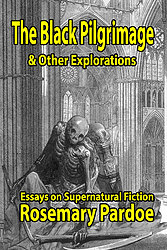
The Black Pilgrimage & Other Explorations by Rosemary Pardoe


The Black Pilgrimage & Other Explorations, essays on supernatural fiction by Rosemary Pardoe is a much-anticipated collection of her non-fiction by a leading authority on the Jamesian ghost story.

The author is often much too diffident about her contribution to the supernatural fiction field and to the small press world, but, as David Sutton notes in his introduction, which gives a useful summary of the author’s writing and publishing work, Rosemary has been active in fanzines for nearly fifty years, and has edited Ghosts & Scholars, the highly respected M R James periodical, in various forms, for nearly forty years.

This volume is therefore the fruit of a lifetime’s devotion to the traditional ghost story (and allied themes), and offers a very generous contents list, with twenty-nine essays on aspects of James, eight essays on his followers, including E G Swain, Arthur Gray, A P Baker and Fritz Leiber, and nine shorter pieces on various subjects which originally appeared in contributions to the postal discussion group The Everlasting Club.

This promises to be an erudite, lively, lucidly written and fascinating book, with unexpected and illuminating insights into aspects of M R James’ stories, and a great deal of other out-of-the-way information.

Who could possibly resist such titles as “Scrying and the Horse-Demon”, “The Magic of Maps”, “’Fluttering Draperies’: The Fabric of M R James” and “The Night Raven”? Here the reader will find pagans and magicians, demons and hobby horses, arcane grimoires, sequestered places, and many other strange byways, all explored in a robust and refreshingly direct way by an author who has quite rightly ignored all the warnings and is perfectly willing to be curious about almost anything, particularly if it is shadowy or peculiar.

Mark Valentine

Sunday, June 3, 2018

Following the Old Ways: Flush As May by P M Hubbard


The tone of P M Hubbard’s first novel, Flush As May (1963), is not dissimilar to the donnish detection novels of Edmund Crispin and Michael Innes: it has the same wit and intelligence and breezily extravagant plot. There are also some conventional figures of the crime novel – a retired Chief Constable, a shrewd older woman, a vague vicar, and several cranky rustics. The plot, involving a missing body, is also fairly familiar. The young woman and her suitor who stumble upon the mystery, and are undaunted by the dark undercurrents when they begin to look into it, are bright, well-developed characters, rigorous in their thinking.

But although the two main protagonists of his book are Oxford undergraduates, town and gown scarcely feature. The setting is mostly in an obscure country village, which seems to be in the Wiltshire Downs, and there are hints from quite early on that this place still observes some clandestine pagan practices. This is again not all that unusual in the field: Gladys Mitchell often features witchcraft, folk customs and ancient sites in her books, and others have done so too.

However, P M Hubbard’s depiction of the village secrets is subtle. Flush As May shows, especially for its time, a surprisingly deep understanding and a certain sympathy for the older religion, and this was to become a hallmark in several of his subsequent novels. There are several ways in which this shows in this book. The first is that it describes very closely a traditional, hereditary witch coven, with its Maid (the matriarchal head), and observance of seasonal customs – Beltane, Lammas and Hallowe’en are specifically mentioned.

I think it is likely that the author drew upon Gerald Gardner’s books on witchcraft, such as Witchcraft Today (1954) and The Meaning of Witchcraft (1959), which were published not long before, although not all that well-known. It is now not generally accepted among historians that any witchcraft coven survived in Britain from pre-Christian times, though there is evidence that particular pagan practices may have done so: it is therefore unlikely Hubbard had personal knowledge of any such group. However, he was clearly well-informed, and this is evidence of a more than passing interest.

The second is that Hubbard describes a network of ancient pathways radiating from a high prehistoric earthwork, The Beacon, and his heroine follows step by step one of the alignments converging on this, starting at a church on a mound, and walking the line through other significant landmarks, such as an ancient wood, a ford, and the north door of another church, up to the hilltop. It is perfectly clear that he is describing a ley line and indeed a character refers, without naming him, to Alfred Watkins and his book The Old Straight Track: its mounds, beacons, moats, sites, and mark stones (1925), the work that began the ley theory.

This again reveals a marked esoteric knowledge on the part of the author: ley hunting did not become better-known until the mid-Sixties, when books and journals began to appear about it; the first issue of The Ley Hunter journal was in April 1965. The author evidently knew about leys before then, and sufficiently well to describe them compellingly, six years before John Michell’s milestone book The View Over Atlantis (1969) made them better-known. Further, he even anticipated the mystical dimension to leys that the sixties brought. This is not to the fore in the Watkins book at all; he thought of them as traders’ tracks. It is possible, therefore, that P M Hubbard is a previously unacknowledged pioneer of the idea that leys had a sacred dimension.

Taken together, these themes from Gardner and Watkins suggest that P M Hubbard had at least looked into these matters quite keenly, and thought them through for himself. There are also some minor clues about the extent of his interest. He alludes to an incident in the history of the Avebury stone circle that later forms the fulcrum of another, also highly pagan, novel, The Dancing Man (1971): this shows that he was thinking about this some time before he wrote that book. In Flush As May, he describes the ancient mound on which the village church stands as “the green round” – a phrase used by Machen for the title of one of his books, involving fairy lore: and we are also told one of Hubbard’s characters has “fairy blood” in her. He may have got these ideas from somewhere else, but since The Dancing Man shows an even stronger likely Machen influence, we may have here a clue that he was already reading him at this stage.

There is therefore not much doubt at all that the author had a strong respect for the pagan old religion he describes. Indeed, he even upends the usual expectations of the detection novel, so that the secret faith of the village may continue undisturbed. He is not an overt apologist for this faith, but clearly understands its allure. P M Hubbard’s book is, for its time, a remarkably sophisticated and shrewd portrayal of modern paganism, and it was to be followed by others equally rich in their use of archetypal images.

Mark Valentine

This note originally appeared in a contribution to a mailing of The Everlasting Club, a postal discussion group for supernatural fiction.

Saturday, June 2, 2018

Finding books in out of the way places


It has sometimes chanced that I have found myself in some out-of-the-way place without a book. This is a disconcerting experience for the keen reader, and recently, in a hotel on an industrial estate, not within obvious reach of any purveyor of literature, I was obliged to read the only thing to hand in the somewhat functional room, namely the breakfast menu. This, though not without interest in its way, did not stretch very far (in terms of reading, I mean: the breakfast itself promised to be, and was, extensive, if unsubtle).

However, on other occasions a chance find in a lonely place has proved to be a solace enhanced by its unexpectedness. Once on a rainswept holiday in Cornwall, and desperate to find something diverting to read, I considered without too much enthusiasm the single creaking plastic carousel of paperbacks in the leaking beach shack which was the only shop for miles around. But what was this? The Adventures of Solar Pons by August Derleth. Some splendid Sherlock Holmes-like detective yarns, just the thing to enjoy while the grey gusts swept against the cottage windows.

Since then, I have to confess to a sort of idle delight in the game of finding something interesting to read somehow, wherever I chance to be. And it is one of the incidental delights of even the smallest, obscurest places in England that it is surprising how often, one way or another, suitable reading matter may be found. Arriving early to meet friends in a minor Shropshire village, for instance, I looked in at the church and found not only one or two paperbacks I could quite enjoy, but also a guide to local ghosts. Later I was able to stroll around in the dusk regarding the apparent haunts it described with an enhanced appreciation, not to say apprehension.

Very few churches are without a printed guide of some sort, and these often make for diverting reading, with unusual anecdotes, snatches of local history or genealogy, diversions upon heraldry, and snippets of little-known folklore. Whether they are simply one sheet folded, or more compendious booklets, it is rare to find one without some points of singular interest, often several.

However, another practice which has begun to become more widespread is that of offering an assortment of second hand books, usually towards the back of the church, to raise funds. One church half an hour from here makes quite a point of it and has several hundred, along with recordings. (Its other attraction is a former Viceroy’s silk dressing-gown, now used as an altar cloth.) Sometimes, admittedly, this may lead to incongruity: one sacred edifice harboured several Dennis Wheatley novels of racy satanism, while in another a biography of Rasputin was prominently displayed.

On another occasion, visiting friends in a little Suffolk village and arriving ahead of time, we went first to look at the church. Here we found in the porch a large cardboard box full of jumbled books for sale, which afforded a most agreeable rummage. Indeed, we were still rummaging when the verger (or was it the churchwarden? A redoubtable lady, anyway) arrived to lock up. Observing the small pile we had accumulated, she invoked the Almighty and declared she had only put them out a few hours before, just to see if anyone would be interested. When we turned up at our friends’ house carrying the spoils, they exclaimed that only we could find a place to buy books in such an obscure nook of the country.

Nor is it only churches that can sometimes oblige the bookless. Another occasional source of reading matter may be found in repurposed telephone kiosks. These elegant scarlet pavilions, no longer required due to the spread of personal phones, have been ingeniously reused by some villages variously as miniature museums, art galleries, greenhouses – or book exchanges, where there might be a few dozen titles available. You may borrow or take one and leave another later.

Some shops now have a selection of books for sale for worthy causes. On one occasion I had walked along the canal to a village from which I proposed to get the train back. There are only half a dozen trains on its almost-forgotten branch line, and, as I had slightly miscalculated, I had an hour and a half to while away before the next one. I recalled, however, that the village florist usually has several trays of books on sale for charity and hoped I might turn up something worthwhile there. I was in luck: it yielded Siegfried Sassoon’s Memoirs of An Infantry Officer, certainly absorbing enough to take back and enjoy on the wooden bench at the little wayside halt, while reflecting that the quiet scene, full of birdsong, might have appealed in its rural tranquillity to the author of the book.

It’s also possible to get second-hand books at some railway stations. When I similarly allowed too much time to catch my train at Oxford station, I was gratified to find that in one of the waiting rooms there were a dozen shelves of books on sale for charity, including no less than five volumes of Jacobean tragedy. These (I admit) I passed over in favour of a history of English glass, a subject that had caught my interest after reading P M Hubbard’s splendid grotesque novel, A Hive of Glass, about the quest for a very rare goblet. Thus it is that, when a suitable occasion arises, I shall be able diffidently to mention, “Ah, yes, Early English Glass. Studied it at Oxford.” “Balliol?” “No, Great Western.”

Mark Valentine

Friday, June 1, 2018

Copsford - Walter J C Murray


In the early Nineteen Twenties, just after the war, a young man tired of living in a back room in the city persuaded a bemused Sussex farmer to rent him a derelict cottage. It stood alone on a hill, had no water or electricity, and was full of rats. Many of the window panes were broken and it was damp, dirty and dingy.

He bought a brush and pail in the village and cleaned it up, fought a war against the rats, then put in some rudimentary furniture. The local postman found him a dog for company, somewhat improbably claimed to be a Shetland collie. Then he started to explore his domain, surrounded on three sides by a stream often all but impassable when in spate.

He lived for a year at Copsford (the name of the house), through all the seasons, while he tried to make a living from collecting, drying and selling the herbs he could find locally, such as foxgloves, agrimony, meadow-sweet, tansy , eyebright and yarrow. He came to know the natural surroundings intimately, alert to the living and growing things around him.

Together with modest payments from occasional journalism, he just about made ends meet (he will share his sparse accounts with us), but it was hard and mostly lonely work. However, he had a friend in the village, whom he calls The Music Mistress, and we’re soon delighted to gather that he and she (and the dog) will be forming a new way of life together there. And some years, and another war, later, he wrote a book about his experiences.

It seems a simple enough story, appealing because of the young man’s doughty integrity, but part of the potency of the book is due to the author’s sensitivity to the unseen. Walter Murray doesn’t only tell us about the practical aspects of making the cottage (just about) habitable, and garnering, drying and packing the herbs. He is also frank about the impressions he received from this haunted site, such as the bleakness he encountered when he first stood alone inside the house:

“And then in an instant the chill loneliness of the place swooped down on me; the cold hand that had rested upon my shoulder now clutched me violently by the throat and the appalling dreariness which so many years’ solitude had fashioned, held me motionless. Those few seconds of my life are graven so deep in my memory that I think nothing can ever efface them . . .”

It’s hardly surprising that an encounter with a desolate empty ruinous house might affect even the hardiest soul, but Murray works hard to convey precisely what it was he sensed. However, it is not only this eerie atmosphere that he evokes: like the protagonist of a Machen or Blackwood story, he is also alert to moments of mystical glory, as in this glimpse one early morning in June:

“It sometimes happens, at rare moments in our lives, we are suddenly aware of an altogether new world, different completely from that in which we commonly live. We feel as though we stand on the threshold of an undiscovered kingdom; for brief moments we understand life interpreted, we perceive meaning instead of things.”

Although his account is firstly a personal memoir and secondly a natural history study, it is also, in its subtle, diffident way, a record of such fleeting visionary experiences.

Copsford (Allen & Unwin, 1948), the book he wrote about his experiences, was an unexpected success and was reissued in 1950 in a popular edition by the Readers' Union. It has become something of a quietly sought-after book since. People who encounter it are apt to be unusually impressed by its fugitive qualities, its curious mood, and by the compelling honesty of the account. Early copies are surprisingly hard to find, even in the RU edition, though there was a HarperCollins reprint in 1986 that is now more readily available.

One devoted champion of the book has recorded The Copsford Project, a short film of a visit to the site of the house, now demolished, where only the front door step and a few other half-buried signs remain. Local historian Tom Wareham has written a biography of Murray, The Green Man of Horam, The Life and Work of Walter J C Murray (2017), and also explores his nature mysticism, which he suggests has elements in common with the work of Richard Jefferies, author of The Story of My Heart (1883).

Murray went on to start a school in the village of Horam, with The Music Mistress, and also wrote about a nature sanctuary he founded there, and published other books of natural history and topography, some in collaboration, and a guide to Romney Marsh. But with Copsford he created one of those singular books, haunted by elusive qualities, that leave the reader wistful, in a mood of mingled joy and melancholy.

Mark Valentine