Thursday, January 6, 2022

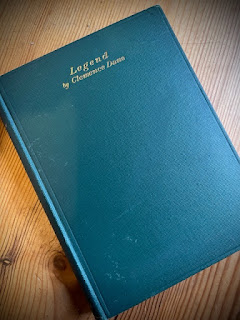
Legend - Clemence Dane

In Clemence Dane’s Legend (1919), Madala Grey, a young woman in her early twenties achieves remarkable acclaim for her books. Visiting her childhood home she meets and marries the family doctor, and dies in childbirth. The news is brought to a gathering of her friends in the fogbound London house of a well-respected, but less successful, critic who “discovered” her, is her literary executor, and is going to write her life, determined that this will bring her similar acclaim. They talk about her.

This novel should not work. For one thing, it is about not one but two authors – in fact, a third, because a diffident cousin of the critic is the narrator, writing this book. And books about authors always seem to suggest a want of invention, a self-referential limitation. For another thing, almost all of the book is in the conversation of this rather superficial clique and all the action, such as it is, in this single evening in the house. Nor is the character of the famous author, as seen through their eyes, all that compelling. Further, Dane reproduces a few passages from her famous author’s books, a risky thing to do because they have to be convincing as the work of an acclaimed genius: and they aren’t.  

But despite these drawbacks in Dane’s novel, I think it does succeed, and that is because of the haunted atmosphere that she is able to create. It is at first obliquely achieved. She has arranged an enclave: the fog is so thick that there are no cabs and even pedestrians cannot see where they walk. So the guests in the house are marooned there. And Madala Grey’s presence is pervasive in the room, at first just figuratively, in the thoughts and shared memories and opinions of this shallow little coterie. There is, in fact, a brief eerie scene in flashback when the young author is wandering in the churchyard of her childhood village and shivers – as if, she says, she had stepped over her own grave, an apparent premonition.

This obsessive going over and over the qualities and characteristics of the famous author builds up a tension. You marvel that Dane can keep it going and hold the reader’s interest in this single subject in this single narrow time and place. Perhaps it is a bit too drawn-out. I began to wonder just how much more Dane could eke it out. But then she brings the curtain down with a final scene that, though it does follow on from what has gone before, is yet a dramatic incursion.

Two of the characters, the narrator and an artist with a strong affinity to Madala, have remained mostly aloof from the circle and are drawn tacitly and tentatively together. The front door opens and only they are in sight of it. The fog seeps in, and with it an apparition that they each see, though they see it differently. We have been very briefly prepared for this, we may now recall, by a passing remark of a character earlier, about seeing the face of the lost one everywhere you look. So there might, just, be a psychological explanation. But this figure is stronger than that: this vision has purpose.

In Legend, Dane has written a novella-length ghost story which is modern in its setting and its technique, yet traditional in its imagery—the fog, the figure at the door, the incident in the churchyard—and in its denouement, the spirit that returns to complete a mission. It is a daring approach, with highly disciplined writing, and it just about works.

I wondered if Dane had in mind as one model for her lead character ‘Michael Fairless’, the young woman who had such a success with The Roadmender (1902), and died young. It would be hard to avoid that example, and although Dane’s character is more sophisticated, she shares with Fairless a deep, simple longing for the countryside. There may be a hint of this origin in the quoted last paragraph of her character’s third and last book, which specifically evokes roadmenders.

Dane’s book now looks like a pioneer in the development of the modernist metaphysical novel. It was followed, for example, by Helen Simpson’s Cup, Wands and Swords (1927), which similarly introduces the supernatural into the affairs of a London artistic set: and in fact Simpson and Dane were good friends and collaborated on crime novels together. There are parallels also with Mary Butts’ Armed With Madness (1928), where quarelling bohemians in Dorset encounter the Holy Grail. All three novels entwine modernity and eternity.

Clemence Dane was also an enthusiast of the novels of Claude Houghton, and contributed to a set of appreciations of him: and his Thirties metaphysical novels have affinities to her work. Indeed, his great success I Am Jonathan Scrivener (1930) uses a similar technique to Legend, of a strong central character described from differing perspectives in the memories and conversations of others, and also has a similar final scene, the dramatic opening of a door.

E F Bleiler, in The Guide to Supernatural Fiction, does not list Legend, but he does include her short story collection Fate Cries Out (1933), and her family saga The Babyons (1928), which has supernatural interludes. He describes the latter as ‘Literate, stylistically interesting Art Deco romanticism’. That would do equally well for Legend.

(Mark Valentine)
 

Monday, January 3, 2022

Arthur Conan Doyle and Souls in Hell

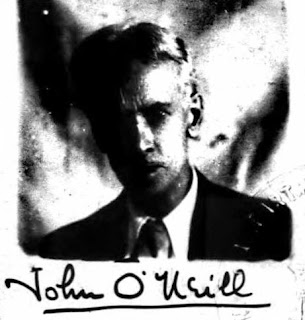
In December 1923, the publisher Nicholas L. Brown issued a novel (dated 1924) Souls in Hell: A Mystery of the Unseen by John O'Neill. It is the only novel by its author, and his only known publication. Nicholas L. Brown was a bookseller in Philadelphia and New York, and a part-time publisher from about 1916 through 1932. I have written more extensively about Brown at Lesser-Known Writers

One of the things that calls attention to O'Neill's novel is that the dust-wrapper has a blurb by Arthur Conan Doyle, noting Souls in Hell "is remarkably fine. It took up two days of my time but it was well worth it--the posthumous experiences reach a height which has very seldom been attained in modern literature. A good story--a fine book." Of course this is not Doyle the ratiocinator speaking, but Doyle the spiritualist. 

Turning to the book itself, what does it offer the modern reader?  Well, it is, as Doyle suggested, a novel of the afterlife. It centers on a vain and louche actor named Karl Benton, who crosses paths with a young war hero Jack Waller.  They have a small skirmish on a ship, but encounter each other again at Jack's sister's house, where Benton is collaborating with the sister's husband on a play. Jack's sister Kitty Cogan and Benton also have a past, a long ago series of student-and-teacher encounters that nearly became the ruination of the sister's maidenly honors. After their second encounter, Benton ends up dead by gunshot. Jack is on the scene, and found to have a recently-discharged handgun in his pocket. Thus he gets put on trial for murder. 

As a mystery this novel is pretty dire. The casual coincidences that move the plot to its end are too silly to be taken seriously. And the writing is at best prolix. Yet the other thread of the plot follows Benton after his death, when he has a Helper who at length begins to instruct him about how he can save his soul. Here the book comes to diabolic life.  For one long chapter (the book has 28 numbered chapters, but confusingly there are two successive chapters numbered 22, and it is the first chapter 22 that is of special interest), Benton wanders in the dismal afterlife and encounters a thing that assails him: "On all sides, blotches of corruption leered and fastened on him--feeding on his flesh! Transparent, livid-colored, creeping things that wormed into his nostrils and ears. Foul, eel-like things trailed over his eyes, and forced their slimy way between his lips" (p. 257). These lead Benton to various temptations and (as the author phrases it) "an apotheosis of carnality" (p. 264). This chapter of some thirty-odd pages, plus surrounding pages of descriptions which include the author's occult expositions, make the book worth reading.  One feels that the author should have written pulp horror, and could have been successful at it. 

And the main thread of the book is not without psychical relevance, as Jack and his sister are defined as being Irish, which apparently gives them privileged insight into the uncanny. And other characters have important interests in such "higher" stuff, and their perceptions and experiences are in the end important to the resolution of the plot.

So who was the author?  He was not easy to track down, but this John O'Neill was born in Dowlais in South Wales on 7 September 1869. He arrived in New York, from Le Havre, France, on 16 June 1895. On 1 July 1899, in New York, he married Henrietta Bertholf, who was born in Hoboken, New Jersey, in 1872.  They had two children, Harold Henry O'Neill (1901-1967), and a daughter Elizabeth, born in 1909, who apparently did not live long. O'Neill worked, according to census records, primarily as an artist. Souls in Hell was apparently his only published fiction. Though I have found no official death record or obituary, O'Neill apparently died  between 1936 and 1940. By the time of the enumeration of the 1940 U.S. Census, his wife listed herself as widowed. (There are hints on his naturalization application that he used the pen-name of "Waller Evans" or "J. Waller Evans" before coming to the U.S., but I have found no instances of such usage.)

Souls in Hell was published in England in 1926 by Methuen under a new title, As We Sow: A Mystery of the Unseen.


Saturday, January 1, 2022

A Rayer Find

On one of our bookshop excursions a few years ago, Mr Howard and I made a pilgrimage to the milieu of the Fifties science fiction writer F G Rayer. We visited the Worcestershire village where he had lived, and searched the local churchyard for his grave, but did not find it, if indeed it was there that his mortal remains rested. There were, however, memorials for several other Rayers who were presumably relations.

We also looked for his farmhouse home, where he wrote his stories and novels, but although we saw some that looked quite possibly his, we did not make a definite identification. The Quest for Rayer was therefore somewhat inconclusive, as such literary expeditions often are, but we did, however, get a sense of the local world in which he had dwelt. There was, for example, a stretch of marshland nearby with a lonely road leading across it, and this certainly had a slightly forlorn air to it.

I had been unacquainted with Francis G Rayer’s work beforehand, but Mr Howard, a connoisseur of early British SF, knew all about him. Rayer was always in poor health from childhood but this did not stop him being an active participant in the emergent futurological scene and a prolific author.  He wrote regularly for New Worlds magazine, and published over a dozen SF novels, including his most noted title, Tomorrow Sometimes Comes (1951).

John Clute at The Encyclopedia of Science Fiction concludes: ‘Much of Rayer's work was routine; but his portrayal of 1950s England is evocative, and his bent towards Post-Holocaust and Ruined Earth venues – as in the case of his more famous contemporary, John Wyndham – underlines the pessimistic undertow that characterizes so much UK sf in general.’

However, the energetic and ingenious Rayer also wrote numerous technical books for amateur boffins, such as Electrical Hobbies (1964), Amateur Radio (1967), How to Build Your Own Metal and Treasure Locators (1976), How to Make Walkie-Talkies (1977) and How to Build Your Own Solid State Oscilloscope (1979). I began to wonder whether, somewhere in that quiet village backwater, there might be found his MS work-in-progress on How to Build Your Own Time Machine.

The indefatigable Rayer also wrote articles for radio operator magazines, and a few of these came to light when, some time later, I was browsing at a bookstall in a local village hall flea market, where I found some vintage issues of Practical Wireless edited by F J Camm.

I liked the covers of the periodical and the pictures inside of fearsome looking equipment, and I had a vague idea that perhaps some unexpected authors might write for it, so I bought a few. When I perused them at leisure, sure enough, there were a couple of issues with features by F G Rayer (most of the contributors seemed to favour initials, both before and after their names).

He contributed an article on ‘Radio Controlled Models – Details of Some Crystal Stabilised Control Transmitters’ to the May 1955 issue, which has a picture of the Jodrell Bank observatory on the cover. The article has a forthright beginning: ‘The output of a self-excited transmitter with a given number of valves is greater than that of a crystal-controlled transmitter with the same number of stages, but the latter has the advantage of maintaining frequency accurately’.

Who can doubt it? I ‘m not sure I know what a ‘self-excited transmitter’ is, although I feel I may have met a few. We will pass swiftly over the diagram for ‘Two common types of coupling arrangement’. The article concludes with the admonition that ‘the meter should not be near a super-regenerative receiver, or a reading may be obtained from the latter, thereby confusing results.’Super-regenerative', eh? This begins to sound slightly ominous. What exactly is being super-regenerated?

The article by Rayer in another issue concerns how to construct a tuning meter, using only easily available spare parts. Rayer’s technical work appeared around the same time that a new cavalcade of UFO zines were reporting sightings all over the country. I cannot help wondering if there might be some connection. This mysterious instrument was doubtless intended for clandestine extra-terrestrial contact.

It might be a plot in one of his own novels. What if a highly adept SF author, under the guise of harmless electronic experiments for the hobbyist, was really seeding  contact points for Other Powers?

(Mark Valentine)


Monday, December 27, 2021

Removing a Story (via misattribution) from Fitz-James O'Brien's oeuvre

 A bibliographical point came up on a list-serve I'm on, and with the permission of fellow-researchers Phil Stephensen-Payne and Endre Zsoldos I recap it here. 

The story known as "A Dead Secret" appeared anonymously in Harper's New Monthly Magazine for November 1853.  Francis Wolle, in his seminal Fitz-James O'Brien: A Literary Bohemian of the Eighteen-Fifties (1944), noted that the story is in "one of the various styles in which O'Brien was accustomed to write, and it alone deals with the sort of material which later became a source of his strength" and he called it "the first of O'Brien's mystery stories" despite noting that the 1853 Index for Harper's New Monthly Magazine attributed only one story to O'Brien for  that year--and the story was not "A Dead Secret." So Wolle's attribution of the story to O'Brien was educated guesswork. 

"A Dead Secret" was collected in Jessica Amanda Salmonson's The Supernatural Tales of Fitz-James O'Brien (two volumes, 1988), and in its one volume form, The Wondersmith and Others (Ash-Tree Press, 2008).  Salmonson clearly included the story in her collection based on Wolle's attribution.  

However, "A Dead Secret" appeared previously (and also anonymously) in the U.K. journal Household Words for 19 September 1853, when Charles Dickens was the editor, publisher, and a major contributor to it. Dickens apparently kept good records, and these were utilized by Anne Lohrli for her book Household Words: A Weekly Journal 1850-1859 conducted by Charles Dickens (1973), and she attributes the story to George Augustus Sala, a frequent contributor to the journal during that period. Lohrli notes that "Six of Sala's H.W. contributions were reprinted in whole or part in Harper's" (p. 114).    

Based on these records, "A Dead Secret" should be removed from the list of Fitz-James O'Brien's stories, and hereafter attributed to George Augustus Sala (1828-1895), an editor, journalist and fiction writer, whose most successful work was probably the novel The Seven Sons of Mammon (1862). Sala pioneered the position of travelling reporter, covering current events around the world.


Thursday, December 23, 2021

A Jar of Date Jam

I always enjoy the adverts in old magazines as well as the literary contents, and indeed several of them have given me ideas for stories. This is particularly the case with classified ads, whose brevity often leaves room for mystery and speculation. But others are just faintly odd, or happen to catch my fancy.

In the Special Christmas Number of the sixpenny magazine The Hiker & Camper, Vol. I, No. II, Dec. 1931, which has on its cover two bright young ladies in overcoats, hats and scarves striding over a snowy field, there is a Classified Advertisement on page 39 as follows:

‘A NEW FOOD FOR HIKERS, RAMBLERS AND CAMPERS.—Dibs, the date jam made from pure clean dates, and manufactured from an old Arabic recipe for the first time in England. Send 3d. in stamps to pay packing and postage for free sample to Dibs Ltd., 26 D’Arblay Street, London, W.1’

The other advertisements in the column are mostly for cafes, hotels and guest houses. We are invited to stay with Miss Dagg of “Utopia”, Wonham Way, Gomsall, Surrey; or at The Sun Patch Cottage; or Hathaway Farm, Stratford-on-Avon, (‘next to Ann Hathaway’s Cottage’), which also offers ‘Catering in Ye Olde Barn’. We may also order a Campers’ Diary and join a Penship Club.

I must admit to a fondness for the fortunes of obscure foodstuffs. J C Squire once lamented that piccalilli had never been the same after the First World War, and this naturally made me wonder why this was so. Perhaps the supply of Zanzibar cloves had faltered, or the cauliflower florets were not so crisp. Or was Squire mingling the memory of the golden piccalilli days with the lost savours of youth?

Jams must have been all the rage in the Thirties. Squire’s literary journal the London Mercury also carried an advertisement for arcane preserves, prepared by a retired military man and his family in the West Country and available in breakfast jars for guest houses etc. They included loganberry and whortleberry as well as the more usual strawberry, damson and blackcurrant. 

But did many hikers, ramblers or campers ever avail themselves of Dibs, on a halt during a staunch tramp? Was it spread liberally between two thick slices of wholemeal bread, or eaten with a spoon straight from the jar? Surely there was a good chance of the exotic provender escaping, and getting all over the maps and the compass and the spare socks and the vagabonding volume by Edward Thomas, or R. Francis Foster, or Herbert W. Tompkins, and moreover staining the pages of their scrolled-up copy of the latest issue of The Hiker.

I wonder whether the makers had aimed at quite the right audience. Connoisseurs of fine food might have been a surer market. And I cannot help thinking that Dibs, though succinct and friendly, was not quite the right name for a date jam that you wanted to present as made from a secret Arabic recipe. I should have thought ‘Saladin’s Delight’ would do the trick better, with some further alluring phrase such as ‘A Taste of the Near East’.

That taste had been fostered by E M Hull’s sultry bestselling desert romance The Sheik (1919), also made into a film (1921) starring Rudolph Valentino in the title role. His name and reputation were still vivid enough over fifty years later for my own surname sometimes to be accidentally or mischievously amended to his. As I was a thin, bespectacled, shy and bookish boy, the contrast with the smouldering-eyed matinee idol was somewhat incongruous. Of course, in my maturity . . .

The zest for the Near East had also been fed by the tales and newsreels of the exploits of T E Lawrence (‘Lawrence of Arabia’), which gave a sense of dash and glamour to a weary public in the immediate aftermath of the Great War, especially when Lawrence attended the peace conferences in the early Twenties in white Arab clothes and headdress.

It seems unlikely that the manufacturers of Dibs could have got the legendary hero to endorse their date jam. He was chary of publicity (except when it suited him) and once sent even his friends a postcard: ‘To tell you that in future I shall write very few letters.’ Still, a cunning designer could have come up with a label that implied Lawrence without strictly depicting him, and a hinting title such as ‘Preserve of Arabia’.

There were many sequels and imitations after The Sheikh, and a similar surge of books and memoirs about the desert war. But the advert for Dibs date jam did not often reappear in further issues of the hiking journal, and the jam itself and the trade name do not seem to have survived into our own times. And now I rather want to know what Dibs date jam tasted like, and whether that old Arabic recipe survived. Rich and sticky and sweet, no doubt of it. I like to think there might have been exotic tints too: rosewater and sherbet, maybe, or cinnamon and cardamom.

Perhaps in some obscure backstreet of a provincial town there is a semi-forgotten celestial grocer’s shop pervaded by the aroma of tea, toffee and aniseed balls, where on a high shelf only reachable by a tapering step-ladder a jar of the original lost piccalilli and a jar of Dibs date jam converse together of old glories.  

(Mark Valentine)