Sunday, February 13, 2022

Strange Case of John Jasper - Decadence and 'Drood'

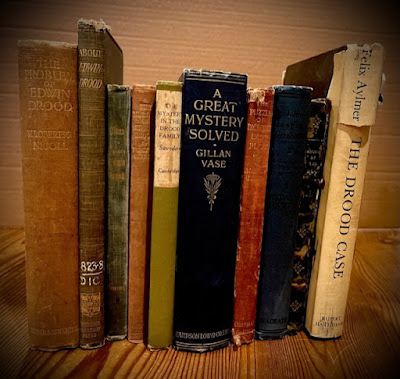
Charles Dickens’ famously unfinished The Mystery of Edwin Drood (1870) has prompted hundreds of studies surmising what was to happen, amateur and academic, and fictional continuations and conclusions, including one supposedly dictated by the ghost of Dickens, and approved by Sir Arthur Conan Doyle in his spiritualist role. They are collectively known as ‘Droodiana’, and I pick them up whenever I see them.

Drood enthusiasts rely upon a number of different sources for clues, including Dickens’ letters, the recollections of his friends, the artwork prepared for the book, and of course the text itself. It is a cheerful game and has been conducted with gusto and ingenuity. A key piece of evidence is in a letter Dickens wrote to his friend John Forster: ‘I have a very curious and new idea for my new story . . .  a very strong one, though difficult to work.’

All who comment, or continue, therefore have got to take good account of that. And it must be said that some of the theories about the book just don’t appear to meet this description. The idea advanced might be ingenious enough, and quite plausible, but is it really so novel, or so difficult? Some of the most popular don’t seem quite up to the mark, as critics have observed.

One persistent idea is that Drood, seemingly murdered and interred in the crypt of Cloisterham Cathedral, in fact survives and returns to haunt his would-be murderer, driving him to confess or to revisit the scene and give himself away. This would be a dramatic plot, no doubt with twists and turns, but it simply doesn’t seem new enough nor, on the face of it, all that difficult: quite conventional in fact.

Another well-supported idea is that Drood’s body, buried in quicklime to prevent identification (as was supposed to be the effect then), is nevertheless identified by a ring which has not perished. This, again, would be a perfectly satisfying crime thriller, but it doesn’t seem striking enough to merit Dickens’ evocation.

A third set of theories or continuations makes use of various permutations of impersonation: one or some of the characters are not what they seem. There is plenty in the first half of the book to support this idea, but again it is hardly new: in fact, imposture and concealed identity are a staple of Victorian mysteries. It is more likely that these elements are in fact red herrings: Dickens was always an artful storyteller and was probably here laying a false scent.

An interesting argument was put forward in a short study, The Mystery in the Drood Family by Montagu Saunders (Cambridge University Press, 1914), dated in the Preface ‘Sept. 1914’. Saunders seems to have published no other book. The author draws attention to what may be a deliberately brief and throwaway allusion in Chapter III to ‘animal magnetism’ and to ‘two states of consciousness which never clash, but each of which pursues its separate course’. This suggests to him that Dickens’ theme was ‘the idea of a murderer attempting and intending to fasten his crime on to another, but in reality tracking himself’.

There Saunders leaves it, but his basic idea may be extended much further. The opium den scene which opens the novel is curious and seems out of place with the scenes in respectable Cloisterham that follow, ’a city of another and a bygone time’, a fictional portrayal of Dickens’ beloved Rochester. The opium den must have some real significance in the novel. And the book as it stands is full of uncanny atmosphere, including premonitions, the scene in the cathedral crypt, mysterious figures, a great storm and a prevailing sense of dread. It is likely that Dickens intended to sustain and intensify this weird quality.

Perhaps, therefore, Drood has indeed been murdered and did not survive, but this was done by John Jasper in a state of delirium caused by his opium visions. When he recovers from these, he has no recollection whatever of the crime, or at most a very dim, unformed sense of tragedy or doom. The theme would, therefore, anticipate Stevenson’s Strange Case of Dr Jekyll and Mr Hyde (1886). But the Jekyll in Jasper, all oblivious to his Hyde role, is outraged by Drood’s murder, has suspicions of another character, and investigates the crime with vigour. What he doesn’t at first realise is that each clue he uncovers is leading, not to his suspect, but back to himself. And when at length the horrible truth forces itself upon him, he tries to cover his tracks, and so awakens suspicion and starts his own downfall.

The ‘very curious and new idea’ that Dickens had, in this reading, was that of an oblivious murderer unwittingly investigating and incriminating himself. It was ‘difficult to work’ because the reader would have to believe that Jasper could commit the crime and yet have no knowledge of it. Also, great skill would be required in portraying the gradual dawning of the truth, and the change in Jasper’s behaviour this induces.  In the Chapter III quotation, Dickens gives examples of the parallel ‘two states of consciousness’, one of them being drunkenness. But opium intoxication is of course even stronger than that, and we have been amply prepared in the opening chapter for its hold on Jasper.

If this solution to Dickens’ intentions is correct, then he was not only writing a highly ingenious crime mystery but anticipating by over a decade the interest in dual personalities found in fin-de-siecle macabre fiction, such as not only Stevenson’s tale, but Wilde’s The Picture of Dorian Gray (1891), Dowson and Moore’s lost novel The Passion of Dr Ludovicus (written 1889-90), and Arthur Machen’s The Great God Pan (1894). What we may have in The Mystery of Edwin Drood, therefore, is the first harbinger of the Decadence, complete with strange drug visions, a fascination with the uncanny, tormented souls, and the singular machinations of evil.

(Mark Valentine)

Wednesday, February 9, 2022

The Centenary of the Book-publication of "The Haunted Woman" by David Lindsay

David Lindsay's second novel The Haunted Woman was serialized in The Daily News in August-September 1921.  I wrote about it here. 

Today, February 9th, 2022, marks the one hundredth anniversary of its publication in book form by Methuen of London.  The dust-wrapper is rather nondescript:

The sheets of the first edition were bound in over a dozen batches, the largest being the first. The are several variants in terms of cloth color and binding stampings, along with catalogues inserted (or not) at the rear. These happened between 1922 and 1926, after which the book went out of print. Here are the variants that, at present, I know of, in probable priority:

1) Brown cloth, stamped in blind on upper cover and in gold on spine. One copy seen without a publisher's catalogue, and another copy reported with an 8-page publisher's catalogue at rear.

2) Brown cloth, stamped in black on upper cover and spine. Reported without publisher's catalogue. 

3) Orange cloth, stamped in black on upper cover and spine. Some copies have an 8-page publisher's catalogue inserted at rear, dated "224" [i.e., February 1924] at the bottom of page 8.  Other copies have a similar publisher's catalogue with the date "425" [April 1925] at bottom of page 8. 

The orange cloth is generally considered to be a remainder binding, sold at a lower price. I present a small gallery below.


The book was not reprinted until January 1947, after Lindsay's death. Victor Gollancz's rather breathless blurb notes that some actually rank The Haunted Women in a higher class than A Voyage to Arcturus. Among the "some" that did, the major proponent of this minority viewpoint was E.H. Visiak.

The reviewer for the T.L.S. of 16 February 1922 clearly expected a different kind of book than the one that was read:

Unfortunately the reader will, we think, feel that he is not quite sufficiently carried out of himself by that sense of the supernatural, which it is the essence of all good ghost stories to create.

The book, of course, is not a ghost story, and doubtless the expectation of it being one led this reviewer astray. 

My views on The Haunted Woman appeared as an Afterword to the 2004 Tartarus Press edition. 


Sunday, February 6, 2022

Arthur Machen and The Mysteries of the Grail

As well as his Grail romances The Great Return (1915) and The Secret Glory (1922), Arthur Machen also used his British Museum researches in a long essay, ‘The Secret of the Sangraal’, collected in the UK edition of The Shining Pyramid (1925), and reprinted with other essays in a Tartarus volume of 1995 where it is the title piece.

It is a judicious and lucid survey: Machen was always practical and hard-headed on occult matters. He discusses and mostly dismisses other theories about the Grail, some with more respect than others, while acknowledging any insights they may offer.

He is clear about his own view: ‘It is my opinion, then, that the Legend of the Grail as it may be collected from the various Romances, is the glorified version of early Celtic Sacramental Legends, which legends had been married to certain elements of pre-Christian myth and folk-lore.'

Machen then idenitifes some of those pre-Christian elements, such as the quest motif and the magic cauldron, but he places more emphasis on the influence of early Celtic saints’ lives, exploring in particular parallels with the hagiography of St David. This is his own most original contribution to Grail studies and still provides an important context today. Some modern scholarship, though, now tends to favour a possible Cistercian influence on the romances even more strongly than the Celtic.  

The great literary and historical enigma of the medieval Grail cycle, which so fascinated A E Waite and Arthur Machen, among others, is how symbols and motifs from Welsh folk stories, themselves embodying elements of pagan religion, became the material of courtly and chivalric French romances of the late 12th and 13th century.

The connection between the two seems indisputable, as Machen points out: 'the origins of the Grail are certainly Celtic. Otherwise one would have to conceive the Anglo-Norman romance writer "mugging up" Celtic literature, learning Welsh, wandering over Glamorganshire and Carmarthenshire . . .' Not only are the characters and places often the same or similar to Celtic tales, but some of the motifs clearly belong together too. But yet we do not possess any text or tradition showing a clear link between the two, how the one became the other.      

Machen, in another essay, proposed that the conduit might have been the courts of Anglo-Norman lords in South Wales, such as, for example, Manorbier Castle, Pembrokeshire, a place he knew well from holidays at nearby Tenby. What more likely, he suggested, than that minstrels and storytellers should recount the wonder stories of Wales before these new conquerors, or that the retinues of these lords should then begin to change the tales to more closely mirror their own world?

R S Loomis (The Grail, From Celtic Myth to Christian Symbol, 1963) however, argues for transmission via Breton storytellers, descended from Welsh and Cornish emigrants and preserving their legends, who took them to Norman courts in the North of France. There is much to be said for this, but it does assume that these tales had survived from the time of British migration to Brittany (say c 500-600) to the early medieval period, so roughly five hundred years. There is still quite a gap here to bridge.

Loomis also suggests a keen Irish influence on the legends that became the Grail cycle, as well as Welsh and Cornish, but he overlooks (because it was then less clearly understood) the probable origin of much surviving Welsh literature in what the Welsh called the Old North, ie Cumbria. The eminent Welsh scholar Rachel Bromwich, studying the Triads, was among the first to identify this origin.

Loomis rightly says that a chief difficulty is that hardly any Breton or Cornish literature has survived, but the same is even more true of Cumbric literature, virtually effaced. This is not to deny any Irish influence on the legends, for, as he says, interchange between the two cultures was strong, but rather to notice that there is a closer possible source.

Constance Bullock-Davies, in a paper on ‘Professional Translators and The Matter of Britain’, suggested another theory. She points out that in post-Conquest Britain there were at least four languages in regular use: English, Welsh, Norman French and Latin, and that rulers and their retinues needed trustworthy people who could translate their orders for them. Royal and noble households therefore had official translators, known as ‘latimers’ (the origin of the Latimer surname).

We may be apt to under-estimate how important this role was, but latimers were often of high social standing and well-rewarded. Bullock-Davies proposes that it was through these officials that Welsh folk tales might have found their way into Norman society. There is no direct evidence for this, but it certainly seems plausible as at least one of the conduits.

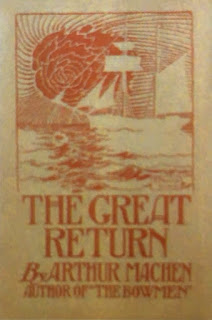
A keen insight that Machen brought to discussion of the Grail was the point that there are other sorts of relics associated with early Celtic saints, in various forms, such as their bell, staff, stone altar, and these had sacred properties too, eg of healing or prophecy. He evokes these in The Great Return (1915), where there are three sacred relics, each in the care of one of the three saintly and mysterious ‘Fishermen’: the portable altar of many colours, Sapphirus; the holy bell that is heard from the headlands and at sea, filling the air with a sweet but powerful music; and the holy cup.

As both Machen and Loomis also note, the Grail takes different forms in the various romances. It is not always a cup. In the first (Chrétien de Troyes) it is a serving dish: and in the Parzival legends it is a stone. It is also sometimes accompanied by other sacred objects. The four Grail “hallows” or holy objects of myth are the cup, lance, sword and dish.

There is, however, another elusive idea about the Grail which hovers over 20th century depictions of the myth. It is the idea of the Grail as an ethereal presence in the landscape. Machen implies this in The Great Return, and it is expressed repeatedly by Mary Butts in her journals, where she records her sense that the Grail is about to descend on the Cornish village of Sancreed.

It is deployed in a highly metaphorical way by Charles Williams in his Arthurian poems, and it is also so treated by Anne Ridler in her poem ‘Taliessin Reborn’ (1942), a sort of pendant to Williams’ work. A similar concept is found in the mythic poetry of David Jones and implied in some of the poems of Sally Purcell. The Grail Legends continue to transform, reaching out now to suggest a symbol for our need for a spiritualised landscape. 

(Mark Valentine)


Tuesday, February 1, 2022

Centenary - 'The Secret Glory' by Arthur Machen

This year marks the centenary of the first book publication of The Secret Glory, Arthur Machen’s romance about a youthful bohemian who encounters the Holy Grail.

We don’t know the exact day of publication, but the Gawsworth biography of Machen tells us that on 18 January, writing to his friend Harry Spurr, Machen said: ‘The Secret Glory will be published by Secker in a few days’. The Goldstone & Sweetser bibliography of Machen says it was first published in February, and on 20 February, Gawsworth reports, the book ‘appeared to be doing well’. There was a reprint in March. This at least suggests that the Machen ‘boom’ started by his American admirers (and later carried on by Gawsworth’s own efforts) had stimulated sales.

The main theme had interested Machen for some time. Machen told his friend the musician Paul England, in 1906: ‘I have been amusing myself lately by going to the B.M. [British Museum] where I make researches into the origins of the Holy Grail Legend to gratify a curiosity excited by Waite’s ingenious but (I think) mistaken theory on the subject. He is inclined to believe the Legend the cryptic manifesto of the ‘Interior Church’: he would love to connect it with Cabalism, the Templars, the Albigenses . . .’

Machen’s great friend A E Waite, scholar of the esoteric, was to present his theory in The Hidden Church of the Holy Graal (1909). Machen’s own idea, however, was that the Grail represented a tradition of a lost ritual in the independent Celtic church, suppressed but still remembered when the Roman church became dominant. He was influenced in this by the traditions of healing cups (and other relics) associated with Celtic saints in Wales, Cornwall and Cumbria (the latter was originally the Welsh-speaking Old North).

I describe this interest in my essay ‘Holy Treasures – Three Arthur Machen Mysteries’ (A Country Still All Mystery, 2017), with particular reference to the genuine tradition of the St Teilo relics, kept under the care of two families for over 500 years. The Nant Eos Cup, which is now on loan to the National Library of Wales, Aberystwyth, may well have been another inspiration.

The Secret Glory was mostly written in 1907. Passages either directly from the novel, or similarly inspired by his Grail researches, were published in The Academy in 1907-8; and the opening was later published in two issues of his fellow New Bohemian Henry Savage’s short-lived journal The Gypsy in 1915 and 1916: this comprises pages 1-22 of the book.

The book had another inspiration, as well as the Grail legends. Machen had been irritated by a foolish, fawning tribute to a former Public School head master that he had chanced to read: and he also harboured the bitter memory of how Harrow public schoolboys insulted and indeed assaulted the actors of the Benson Company when they came to perform Greek tragedies there. The Secret Glory therefore also includes biting satire on the Public School ‘ethos’.

However, even in its first book publication the novel was not complete. The first edition was published without two further chapters. These were first issued in a pendant volume by Tartarus Press in an edition of 250 in 1991, and Tartarus have since issued the full novel, with the restored chapters.

Even so, in its original incomplete version the book had a strong influence on its readers. John Betjeman describes, in his verse autobiography Summoned By Bells (1974), how a copy was given to him by a Cornish priest and had a profound effect. Years later, in sending a cheque to the Machen appeal fund, he wrote: “I really owe Arthur Machen more than money can show”, for, he said, the book had made him a High Church Anglican when he had been a Public School Evangelical, aged 15.

That High Churchery was so much of a part of Betjeman’s persona, and his writing, that the book must indeed have been a talisman for him. Colin Summerford, the young man Betjeman was writing to, who had organised the appeal fund, also came to Machen through reading the book, when he was a public schoolboy at Winchester. Under Machen’s guidance he also undertook research into the Grail legends.  

A letter from Machen to Summerford of 12 February 1924 hints at the significance of the ‘Secret’ aspect in his book. He refers to ‘one of the distinctions between the Roman and the Celtic churches: the Romans exhibit their relics as much as possible to excite the devotion of the faithful: the Celts kept their relics in secrecy; it was dangerous for the unqualified to look on them. You see how this bears on the Grail legend; how it is one of the many small points which tend to establish the general conclusion: the Legend of the Grail is, in one of its aspects, the Legend of the Celtic Church’.

As with many of his books, The Secret Glory catches fire when Machen is writing about two of his greatest inspirations: London bohemianism, and the lore and landscape of Wales. He had long given up hope of writing the Great Romance he had ever imagined, but the book is a further fervent and lyrical approach to this impossible ideal.

(Mark Valentine)