Saturday, March 19, 2022

Ancient Origins of English Inn Signs

The origins of English inn signs remain obscure, and the usual explanations, where there are any, have rarely, if ever, been tested. And yet here is a remarkable form of popular heraldry, full of strange beasts, legendary figures and quaint old lore. As the poet Edward Thomas put it, when he was describing a walk through the outskirts of nocturnal London, ‘the names of the inns were as rich as the titles of books in an old library’ (The Heart of England, 1906).

What Inn-Signs Tell! by Whittoney Block is listed in the bibliography to The Spotted Dog (1948), an enjoyably urbane book on the same subject by Reginald Turnor, which has attractive engravings by John Farleigh. The Block book was published by Imprimerie Mentonnaise in their Editions France Riviera. The British Library catalogue says it was published in 1929 and that Block was a pseudonym for Lady Caroline Ella Eve: no details of her appear. There is no other book listed under either name.

It is an enjoyably eccentric study of the subject. The opening chapter, ‘The Green Snake’, recounts how the author met an American tourist at an inn who wanted to know what the signs meant, and so she decided to investigate, in an open-top Panhard car, the Green Snake of the title. Inn names ‘were jotted down whilst passing through town after town and village after village’.

The book begins, however, by tracing the prehistoric origin of all signs (not just those for inns), first as pictures, then as pictographs, then as alphabetical letters. Then it discusses which are the oldest symbols, and argues these are the Ship (or Ark), Bull, Star, Half Moon, and then, radiating from these, the Bell, Peacock and Magpie: the argument for their precedence and succession is sometimes rather arcane.

The essence of the book is given in a single sentence early on: ‘The Inn-signs of England are the symbols adopted by an Eastern priesthood to teach the people their own particular faith.’ How did these images come to Britain? Well, says the book, rather breezily, ‘it may be strongly suspected that these hieroglyphics were conveyed to The Isles of the Setting Sun by the maritime people who first lived on the Bahrein Islands in the Persian Gulf’ (p.79).

This is an interesting variation on a quite frequent esoteric idea that Phoenicians came to Britain trading in tin, though here applied to an even more ancient people. The derivation of inn signs from ancient symbols is also advanced in a later book, The Rising Sun: A Study of Inn Signs (1937) by H T Sherlock, though there the derivation is more specifically from the Egyptian mysteries: the Rising Sun sign is seen as a symbol of Osiris, and others are shown, often ingeniously, to be of a similar nature. The idea is that inns developed as stopping places for pilgrims (this much is conventional history), but in this case those on the mystical journey to the west (this is rather less conventional).

The reason that the origin of inn signs can be attributed to either Mesopotamian or Egyptian mystery cults, neither on the face if it exactly probable, is that they have been so little studied. The explanations given for many of the most popular signs, which have often continued unchallenged since an early Victorian study, are unconvincing. Amateur researchers are therefore free to go their own way, and they certainly do!  

I have been studying them on and off since my teens when, like the author of What Inn-Signs Tell!, I wrote down the name of every inn we saw on family car journeys. They are not always what they seem. I discuss the Saracen’s Head sign in Sphinxes and Obelisks (2021), and the Red Lion in Echtrai, Edition One (2022). I have been unable to resist them in fiction either, as in ‘Red Lion Rising’ (Supernatural Tales 40, 2019).

And indeed I do think there could be more to tell of, among other signs, the Black Lion, the White Hart, the Raven, and the Green Man. It sometimes seems as though inn signs are the symbols and the focus of some great alchemical experiment in the landscape of England. If only these majestic figures could be invoked at the right time and in the right order, then . . .

(Mark Valentine)

Saturday, March 12, 2022

Greenidge Dream Time

Philip and the Dictator: A Romantic Story (1938) by Terence Greenidge is another in the sub-genre of fantasies involving imaginary North Atlantic islands, such as The King of Lamrock by V Y Hewson, The Dark Island by Vita Sackville-West and Hy Brasil by Margaret Elphinstone. Others, such as The Master by T H White and the Princes of Sandastre fantasies of Antony Swithin are set on the real, but greatly elaborated, island of Rockall.  

In Greenidge’s novel, a young man, Philip, working in the newsreel industry, cutting and splicing footage, steps out of his Wardour Street workplace for a smoke and is transported through a drain cover to a different plane. He finds himself on a train in St Michael’s Isle, which lies in the mid-Atlantic between Britain and America. It is a former British colony that has achieved independence but retained its own king: the reigning monarch was a schoolfriend of Philip, in England.

Greenidge’s hero (modelled on the author) soon finds himself embroiled in the politics of the island, and a romance with the English-born queen: an influence is clearly Antony Hope’s The Prisoner of Zenda (1894), though with a less swashbuckling panache. The Dictator of the title is a General who leads the dominant party on the island and has autocratic tendencies: a poker-faced note at the start of the book assures us he is not based on Franco.

The idea of the mid-Atlantic island is well-realised, with a plausible sense of how such a territory might develop, and the switches from Philip’s London life to this fantasy realm (he goes to and fro several times) are achieved briskly and without tiresome explanation. The novel has a languid charm, not taking itself too seriously, and the satire on contemporary times is also fairly lightly-worn.

In asides, the author takes the opportunity to praise other books he likes, including Moonfleet by J. Meade Falkner and A Glastonbury Romance by John Cowper Powys.

Terence Lucy Greenidge (1902-70) was the author of several satirical fantasies, and also of poems, plays and essays. Some titles appear to be self-published from a correspondence address, BM Hegel, and others were with the Fortune Press, often a subsidy publisher, who had an interesting reputation: Timothy d’Arch Smith portrays the Press in an entertaining chapter in his The Books of the Beast (1987).

Greenidge’s first publication, Degenerate Oxord? (1930), a defence of contemporary varsity youth, was, however, with a major publisher, Chapman & Hall, probably through the influence of Evelyn Waugh, who had published Decline and Fall (1928) with them. Greenidge had made an amateur film featuring Waugh and Elsa Lanchester, The Scarlet Woman: An Ecclesiastical Melodrama (1924), a Firbankian satire about a Roman Catholic conspiracy to convert the Royal Family (it is free to view at the BFI).

Greenidge was part of Evelyn Waugh’s aesthetical, camp and louche circle of Oxford friends, somewhat in the Brideshead mode. Waugh recalled in ‘A Little Learning’: He was the orphan son of a don & the ward of the Bursar of Hertford College. An ex Rugbeian, an enthusiastic Greats man, given to declaiming Greek choruses loudly, late at night, in the quad’. 

Another novel, Tinpot Country: A Story of England in the Dark Ages (1937) is described on the dustwrapper as ‘a remarkable account of life in an English film studio. But the film industry is treated merely as a typical institution of post-war England, which—far from being a land fit for heroes—with its false values and its speeding-up of everything threatens to destroy those who have learnt true values and felt the slow march of real progress, perhaps even at an ancient seat of learning. The New Morality certainly enters into the hero’s managing of love affairs, but he was with the ages when he concentrated on Beauty and forgot everything else . . .’

A later publication was Girls and Stations (1952), a book of poems introduced by his friend John Betjeman, who applauds the strong railway interest: there is a sonnet sequence based on the little-known Bletchley-Oxford line. Greenidge ran an informal society of fellow high-spirited young men, the Railway Club, whose purpose was fine dining on obscure trains

A Checklist of Publications by Terence Greenidge

Degenerate Oxford? A critical study of modern university life (Chapman & Hall, 1930)

The Magnificent. A story without a moral (Fortune Press, 1933)

Brass and Paint: A Patriotic Story (Chapman & Hall, 1934)

Tinpot Country: A story of England in the Dark Ages (Fortune Press, 1937)       

Philip and the Dictator. A romantic story (Fortune Press, [1938])

Sonnet sequence on the Oxford and Bletchley branch. By a Master of Arts [i.e. Terence Greenidge] (BM/Hegel, [1947])

Ten poems, mostly amorous. By a Master of Arts (BM/Hegel, [1948])

Girls and Stations, etc. [Poems.] (Fortune Press, [1952])

Four Plays for Pacifists, etc (Glasgow: Strickland Press, 1955)

My Philosophy. By a Master of Arts (BM/Hegel, [1955])

(Mark Valentine)

Image: BFI

Friday, March 4, 2022

Dunwich

To Call is a mimeographed journal edited by artist and printer Petra Schulze-Wollgast. The latest issue, no 16, with the theme of crisis, includes my typographical poem ‘Dunwich’, as well as works by other artists and poets.

The magazine is printed on Gestetner 320 and Gestetner 160 duplicators on old typewriter paper, and hand-collated, in an edition of 130 copies.

It will appeal to that possibly elusive or even illusory coterie of connoisseurs interested in any or all of vanished cities, experimental poetry, semi-obsolete printing and the complete works of M Valentine.

(Mark Valentine)

Monday, February 28, 2022

J Sheridan Le Fanu - Irish Master of Mystery - Talk


Editor, author and Wormwood stalwart Jim Rockhill will be giving an illustrated Zoom talk on J Sheridan Le Fanu, Irish Master of Mystery on 28 August 2022 at 2000-2130 BST. 

It is in association with The Viktor Wynd Museum and the Last Tuesday Society. Edward Parnell, author of Ghostland, will host the event. 

The announcement reminds us that M R James was a great enthusiast of Le Fanu:

' In the “Prologue” to Madam Crowl’s Ghost and Other Tales of Mystery (1925), his invaluable gathering of Le Fanu’s hitherto uncollected stories, no less a practitioner of the form than M. R. James pronounced: “Le Fanu stands absolutely in the first rank as a writer of ghost stories. That is my deliberate verdict, after reading all the supernatural tales I have been able to get hold of. Nobody sets the scene better than he, nobody touches in the effective detail more deftly.” '

Jim is a deep scholar of Le Fanu who has edited collections of his supernatural stories and of essays on the Irish visionary, and (with Brian J Showers) an anthology of stories inspired by him, among many other important editions.

Please follow the link for full details and to book.

(Mark Valentine)


Friday, February 25, 2022

The Egg Language

One of the effective devices used in Arthur Machen’s renowned short story ‘The White People’ (Horlick’s Magazine, 1904) is the use of words which apparently mean something important to the nurse and the girl of the story but are not from any known tongue. These include ‘Dôls’, ‘voolas’ ‘the Aklo letters’. Elsewhere, Machen uses in his stories what at first appear to be harmless child-like signs, a hand drawn on a wall, an arrangement of flints, or games, a version of hopscotch, or being counted ‘out’: these prove to have a sinister import.

In this interest in the peculiarities of children’s rhymes, games and lore, even though he was using it for fictional purposes, Machen was ahead of his time. Though it occasionally interested Victorian folklorists and anthropologists, it was not until The Lore and Language of Schoolchildren by Iona and Peter Opie (1959) that the subject of children’s playground and street culture received significant attention. And Machen’s idea of a child’s secret language, albeit of uncanny origin, was also shrewd, for they do exist.

In one of his journals, the architectural historian James Lees-Milne mentions a private language used by the children of a particular family he knew, noting they were still proficient in it as adults. He refers to it as 'eggy-peggy'. This consisted of adding ‘egg’ before every vowel, or more specifically before the vowel-sound in every syllable. Children could easily become so fluent in it that it was incomprehensible to anyone not in the know. 

A blog post by the romantic novelist Elizabeth Hawksley is the best source I’ve seen on the subject. She calls it Ag, not egg, slang, and gives an example: ‘dago yagou spageak agag slagang’ – do you speak ag slang. She can and does still speak it, as can her brothers and cousins. She says it’s best learnt aged 7-9, as her mother taught her, and she taught her children over a car journey, but is almost impossible to learn as an adult.

From her mother’s use of it she dates it to the interwar period, the 20s and 30s. She notes that it is referenced by Nancy Mitford in The Pursuit of Love (a novel about the Bright Young Things) and is therefore sometimes viewed as a ‘posh’ argot but stresses it is very much not: her own family’s background was lower middle class. [It is actually in Love in a Cold Climate - thanks to a reader for spotting this].

People commenting on her post say they used something similar but used ‘ab’ or ‘ga’. Other versions elsewhere say ‘ig’ or ‘ug’ were used. It is suggested it was primarily a schoolgirl playground language: however, sometimes boys also learnt it. One online forum says it was still in use by school children of all ages in the mid-1960s. It was a word-of-mouth tradition passed on especially between siblings and schoolmates and still used, though not very much spoken about, by some into adulthood.

Speculatively, this made me wonder if the phrase ‘I am the eggman, they are the eggmen’, followed by the nonsense syllables ‘goo goo’ajoob’ in the Lennon/McCartney song ‘I Am the Walrus’ (1967) could be an allusion to the Egg language: the song does use other direct quotations and adaptations from the playground rhymes of John Lennon’s childhood.

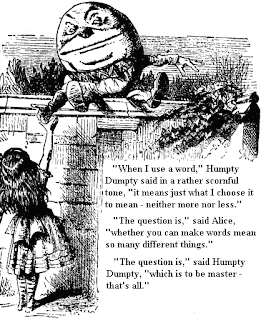
But then there is always Humpty Dumpty, the patron saint of private languages: ‘ “When I use a word,” Humpty Dumpty said in rather a scornful tone, “it means just what I choose it to mean — neither more nor less.” (Lewis Carroll, Through the Looking-Glass, 1871).

There have been other ‘secret languages’ in Britain. A now quite celebrated and well-studied one is Polari, used in gay and theatrical circles in London (mostly) in the Fifties and Sixties, and deployed with comic effect by Kenneth Williams and Hugh Paddick as the camp couple Jules and Sandy in the Sixties radio programme ‘Round the Horne’. Another I have caught passing references to is Cockalorum, which seemed to derive from harbour-side argot.

The comedian Stanley Unwin perfected a unique patter involving mangling and rearranging English words into picturesque neologisms, and contributed interludes in this style to the Small Faces’ album Ogden’s Nut Gone Flake (1968).

But I suppose in specialist circles the Egg language isn’t technically a ‘language’ as such, since it doesn’t have its own words or private meanings, but is rather a masking or obscuring of an existing language. Elizabeth Hawksley quotes the Oxford Companion to the English Language, noting ‘it’s pretty hazy about the subject – not to say snooty’. The OCEL calls this technique ‘Infix’, a term dating back to the 1880s, which is where ‘the speaker inserts a nonsense syllable before a vowel sound to make it difficult for non-infix speakers to understand what’s being said.’

I have chanced across other infix variations. One is Ssssh, which involved mixing hushing and x sounds in with usual words to get a sibilant effect: another, similarly, involves inserting ‘z’ between syllables. As well as insertions, there may be some versions that use omissions. In Violet Trefusis’ Echo (1931) she mentions that the twins of her story ‘communicated solely with each other in a private language utterly devoid of consonants’: much of her book is semi-autobiographical and this idea is possibly derived from some authentic similar tradition.This would presumably be an 'Exfix'.

There does not seem to be, so far as I can tell, any full study of these practices, as distinct from other informal forms of language, such as slang, jargon, dialect or cant, but some are referenced in Paul Beale, updating Eric Partridge, A Concise Dictionary of Slang and Unconventional English (1990). Do any still survive as a living tradition anywhere among children today? How would we know? They are supposed to be a secret. But it could be the case that generational social media jargon, abbreviations and private meanings now perform the same role.

(Mark Valentine)