Showing posts with label Dale Nelson. Show all posts

Monday, December 9, 2019

Guest Post: The Balm of Consecration in Machen’s “The Terror” by Dale Nelson

“The Terror” (1917) stands out as Arthur Machen’s longest horror story, but its plot is simple.  During the cataclysm that was the Great War, a series of bizarre killings besets the “Northern District” and “Meirion” in west Wales.  It turns out that the perpetrators are not human beings, but animals, even moths, who attack people without warning, leaving no witnesses alive. 

First-person narrator Machen declines to state definitively why the animals made these dreadful attacks, but he offers as an “opinion” the hypothesis that they rose up against their natural lord, man, because he had denied his own spiritual nature and his sovereignty; for centuries, he has, as it were, been “wiping the balm of consecration from his breast.” 

American readers, and perhaps many British readers now, too, are likely to miss the significance of this phrase.

Start with this: when Elizabeth was crowned queen of Great Britain in 1953, the event was televised – except for a portion of the ceremony that was deemed especially sacred, and therefore not fit for broadcast by the mass media.  This was her anointing by the Archbishop of Canterbury.

This ceremony – the prayers and the anointing – set apart the monarch, not so much for special privileges vis-à-vis her subjects, but for unique responsibilities under God. 

The archbishop’s application of chrism to Elizabeth may have stirred the imaginations and memories of some of the witnesses.  They might have recalled the old story of how the prophet Samuel anointed Saul, Israel’s first king: “Samuel took a vial of oil, and poured it upon his head, and kissed him, and said, Is it not because the Lord hath anointed thee to be captain over his inheritance?” (1 Samuel 10:1). 

They may have recollected that the Hebrew priests were also anointed (Leviticus 21).  They were set apart as intermediaries between God and the Israelites. 

Many of those present in 1953 would have known a lot of Shakespeare.  The occasion being a happy, though solemn one, they probably didn’t think of the Bard’s black magic play.  In it, when Macduff learns that King Duncan has been murdered, he is appalled:
“Confusion now hath made his masterpiece:
Most sacrilegious murder hath broke ope
The Lord’s anointed temple and stole thence
The life o’ th’ building!”
(Macbeth Act II, Scene 3, lines 65-68)
Like “sacrilege,” that word “confusion” has come down in the world.  In Shakespeare, “confusion” may be the catastrophe that accompanies, or follows as the effect of, “ruin”:
"'Tis much when sceptres are in children’s hands,
But more when envy breed unkind [i.e. “unnatural”] division:
There comes the ruin, there begins confusion."
(Henry VI, Part One, Act IV, Scene 1, lines192-194)
I hope the 1953 coronation wasn’t spoiled for anyone by the thought of such passages in Shakespeare, though their gravity might have been salutary if anyone were inclined to be impatient with, or amused by, the pomp. 

But – a reader may object – how is any of this material relevant to “The Terror”?  There you have nobody killing a king.

The Shakespearean material deals with anointing and the concept of sacrilege.  What Machen’s narrator proposes is that the violence that happened was the result of what amounts to being auto-sacrilege. 

In his theory, the animals did not rise up because (as is often sadly the case) man had abused them.  They attacked him because of his offense against himself as the one consecrated for a unique role in nature.  “The king abdicated” – and he had no right to do that.  He became “self-deposed.”

The theory of man as mediator between God and the brute creation, of man’s viceroyalty, is something that was once familiar but is now hardly part of the cultural imagination.  Our understanding of Machen’s fiction, and our imaginative engagement with it, may be compromised.

Machen’s narrator leaves to the reader whether or not to accept his strange hypothesis about why the animals attacked people – and, since the story, after all, is fiction, the stakes are low.

Or rather, the stakes today are high – if not for us, for the animals.  Shall human beings consider ourselves responsible for the domestic and wild creatures that are, whether we like it or not, our subjects?   

Animals can’t be stewards of us; we can’t not be stewards of them.  We can only be good stewards or bad stewards. 

Notes

I referred to “The Terror” as Machen’s “longest horror story,” since I see The Three Impostors as a collection of linked stories rather than as a novel.

A good book about human sovereignty and stewardship is Matthew Scully’s Dominion: The Power of Man, theSuffering of Animals, and the Call to Mercy.

Admirers of The Lord of the Rings should read Evans and Dickerson’s Ents, Elves, and Eriador: The Environmental Vision of J. R. R. Tolkien, which is a much better book than its cheesy main title would lead one to expect.

The present article is a sequel to my earlier Wormwoodiana posting, “Arthur Machen’s Secret HistoryTale ‘The Terror.’” That article expounded the traditional ontological hierarchy of “levels of being.”

It’s curious to note, by the way, that Machen’s story seems to have been written just before the abdication of the anointed Russian emperor, Tsar Nicholas II, in early 1917. 

Tuesday, November 26, 2019

Guest Post: Machen and the Dark Specter by Dale Nelson

In three recent articles, I’ve argued that Arthur Machen probably drew upon the writings of Ovid, the historian Josephus, and the Bible to suggest, subtly rather than explicitly, the nature of the horror of violation that occurs in “The Great God Pan” and “The Inmost Light.”

Here, I’ll comment on “Fragments of Paper” (also called “Psychology”), which is a sketch, and “The Novel of the White Powder.”  Where in “Pan” and “Light” the innocent sufferers were women, in these two pieces the sufferer is a man, and he is not innocent.

The “fragments of paper” are scraps that Mr. Dale wrote on during a sunny day at home, which was mostly busy with unspecified work.  “On them he had carefully registered all the secret thoughts of the day” without thinking about them, getting back to work till he jotted the next note and put it aside.  When he reviewed them, he was shocked by “the crazy lusts, the senseless furies, the foul monsters that his heart had borne” that the scraps recorded.

He has learned that “every day we lead two lives. … I say I am a man, but who is the other that hides in me?”

“Powder” is narrated by the sister of Francis Leicester, a diligent student of law.  Miss Leicester became anxious about the toll on her brother’s health of such long, sedentary hours, so he reluctantly consulted the family physician, Dr. Haberden. 

Francis had his prescription filled, despite his sister’s misgivings, at a neighborhood shop kept by an elderly pharmacist.  Francis perked up and exhibited a new taste for London night life, but eventually sequestered himself in his room.  There is a horrified glimpse of a monstrous face and paw at his window, some nasty black fluid drips from his room into the room below, his door is at last broken down, and a vile bubbling black pool of corruption is revealed, which is what Francis has become thanks to the drug.  It turns out to have been identical with the “wine” of the Witches’ Sabbath.

What may lift this shocker above the level of a pulp thriller are its superior generation of suspense, its narrative and descriptive craftsmanship (including a bit of Machen’s famous evocation of Strange London) -- and the final few pages.  A wrap-up that conveniently explains things is a familiar device in popular fiction, but uncommon is writing such as this:

“There [in some forest depth or remote cave], in the blackest hours of night, the Vinum Sabbati was prepared,” and the neophytes “partook of an evil sacrament. … And suddenly, each one that had drunk found himself attended by a companion” of alluring evil, which was, “awful as it is to express, the man himself. … the worm which never dies, that which lies sleeping within us all, was made tangible and an external thing, and clothed with a garment of flesh.  And then, in the hour of midnight, the primal fall was repeated.”

These sonorous lines were written to Dr. Haberden by the friend who analyzed the white powder and detected its real nature.  The friend comments, “for so terrible an act as [the partaking of the “wine”], in which the very inmost place of the temple was broken up and defiled, a terrible vengeance followed.  What began with corruption ended also with corruption.”

We’ve seen that imagery of the violated temple before, when the victims were women.  Exactly how to reconcile that imagery with the imagery of the inmost “worm” and the reference to the Fall is more than I will attempt here.

Mysteries of theology, unlike mysteries of detection, may be contemplated but not exhaustively explained.  Machen’s imagery points to a mystery of theological anthropology.  

To take one authority on it: the Lutheran theologian Johann Gerhard – who was hardly likely to minimize sin – taught, on one hand, that “the very essence of the soul” was not lost at the Fall.  Sinful man does not require a new soul in order to be saved, nor does he acquire a new soul at Baptism. 

Yet, on the other hand, Gerhard added, man “from being righteous and holy became impious and unrighteous … Having lost the most beautiful image of God, man put on the dark specter of the devil.”  (That sounds Machenian, doesn’t it?)  Gerhard says, “we bear no longer the image of God and of the heavenly Adam, but the image of the earthly Adam. … we are by nature alienated from God,” although we possess “remnants of that original divine image,” etc.; hence the new birth in Christ is necessary.

Machen drew upon beliefs such as these for the purposes of literary art when he took pen in hand to write weird fiction; he was a poet more than a mystic, theologian, or parson; but he took those beliefs seriously, verbal signs of contradiction though they were in his time as they are in ours.

I think that Machen would have liked this statement:

“Only fools have clear conceptions of everything.  The most cherished ideas of the human mind are found in the depths and in twilight: around these [perplexing] ideas which we cannot [master] revolve clear thoughts, extending, developing, and becoming elevated.  If this deeper mental plane were to be taken away, there would remain but geometricians and intelligent animals; even the exact sciences should lose their present grandeur, which depends upon a hidden correlation with eternal truths, of which we can catch a glimpse only at rare moments.  Mystery is the most precious possession of mankind.  Not in vain did Plato teach that all below is but a weak image of the order reigning above.  It may be, indeed, that the grandest function of the loveliness we see is the awakening of desire for a higher loveliness we see not; and that the enchantment of great poets springs less from the pictures they paint than from the distant echoes they awaken from the invisible world.”

© Dale Nelson

Notes

Johann Gerhard (1582-1637) is quoted from pp. 61 and 63 of The Doctrine of Man in the Writings of Martin Chemnitz and Johann Gerhard, edited by Preus and Smits (Concordia Publishing House, 2005), pp. 61 and 63.

The long unattributed quotation (“Only fools”) is from the Russian reactionary and anti-Semite Konstantin Pobedonostsev, Ober-Procurator of the Most Holy Synod (1827-1907).  Curiously, it is possible that Machen saw the book, Reflections of a Russian Statesman, in which the quotation appears.  It was issued by Machen’s own eventual publisher, Grant Richards, in 1898, translated by Robert Crozier Long.  I quote from the Ann Arbor Paperback reprint, 1968, p. 188.

Monday, November 18, 2019

Guest Post: The Abomination of Desolation in Machen’s “Great God Pan” and “The Inmost Light” by Dale Nelson

In an earlier article, I proposed that part of Clarke’s dream in the first chapter of Machen’s “Great God Pan” recalled the eve of the Jerusalem Temple’s destruction in AD 70, as recounted by the historian Flavius Josephus in The Jewish War, a book formerly well-known in Whiston’s translation.

Machen’s character Clarke dreamed of a voice that cried, “Let us go hence!” and the tome of Josephus reported that the priests heard a multitude of voices calling “Let us remove hence!” before the triumphant forces of Titus overthrew the Temple.  Clarke’s dream foreshadowed the sacrilegious violation of a young girl’s spiritual integrity because of a successful brain experiment.

I will argue that an account of the violation of an earlier Temple illuminates Machen’s theme.  Here again, Machen is (I suspect) drawing on an old book – this time, the Bible – that is much less a part of education, the arts, etc. today than formerly.

“‘When ye therefore shall see the abomination of desolation (spoken of by Daniel the prophet), stand in the holy place’ – whoso readeth, let him understand – ‘then let them which be in Judaea flee into the mountains’” (St. Matthew 24).  These words of Christ refer, in context, to the prophesied destruction of the Temple of Jesus’ day, the Second Temple, the taking of which by Roman soldiers about 40 years afterwards was described by Josephus. 

But the words allude also to the Old Testament book of Daniel 9:27 and 11:31, which the interested reader may look up.

However obscure these texts may be now, they were familiar to many when Machen was young.  I won’t attempt to summarize the reasons why the Daniel passages have been taken to have a twofold fulfillment, first at the time of Antiochus Epiphanes IV, who ruled 175-164 BC, and then in AD 70.

Under the Seleucid king, the Temple was defiled: the king’s forces set up in it an idol of a pagan god, prevented the Israelite sacrifices from being offered, and may have polluted the altar with the blood of pigs.  Under the Emperor Vespasian, over 200 years later, the Temple was, again, subject to outrage.  In a war of appalling carnage, Titus ended the Jewish sacrifices and thrust the Roman standards into the sanctuary.

That, basically, is the historical meaning of “the abomination of desolation” or the “abomination that makes desolate.”  The hallowed place, sacred to God, is broken into, something sacred is lost or departs from it, and something unholy takes its place.

Readers of Machen’s horror stories will see the parallel I’m proposing.

The orphan girl Mary is violated; “the soul seemed struggling and shuddering within the house of flesh”; she is left a ruin, an “idiot” who dies before a year has passed.  But something horrible took possession of her body so that nine months later she gave birth to Helen Vaughan, with whose deplorable activities much of “The Great God Pan” is concerned.  When Helen is forced to kill herself, a ghastly corruption is revealed.

Likewise, in “The Inmost Light,” Dr. Black experiments on his innocent, consenting wife.  Black wrote that “from some human being there must be drawn that essence which men call the soul, and in its place (for in the scheme of the world there is no vacant chamber) – in its place would enter in what the lips can hardly utter, what the mind cannot conceive without a horror more awful than the horror of death itself.”  Black’s experiment is successful, and a Poesque mass of bubbling black corruption results.

In each story, an “abomination of desolation” follows upon violation.

Please note: I don’t say Machen wrote these stories intending that they would be interpreted as religious allegories, and, so far as I know, by and large they haven’t been.  He wrote more as a poet than as a mystic, much more as a poet than as a theologian, and much, much more as a poet than as a parson; to say which is not to disparage mystic, theologian, or parson.

Machen wanted to write tales of suspense, wonder, awe, and horror, and, so far as I know, for decades many readers have found these stories first rate of their kind.  The literary allusions I’ve expounded – if they are there – are part of the man’s artistry, and have worked mostly as undertones.

Except that, as Ovid, Josephus, and even the Bible have ceased to indwell many readers’ imaginations today, such readers might hardly sense those tones.

Machen may now be faulted by critics who lack the imaginative formation he and many of his readers shared.  For some of these critics, it’s too late to become naturalized to that country, that spacious, and almost lost, realm of the Greek and Latin classics, the Bible and religious tradition, the standard English authors such as Milton and Browne and Wordsworth.  In new Machen reprints, footnotes may identify some of his references and allusions, but few or no associations with personal formative imaginative experiences will be evoked in readers, because that formation didn’t happen.  To be told that the allusions are there is not to feel them as undertones as one reads the stories --.

When Machen treats of the human being positively, as a divine creation, though threatened by evil, the victims are female.  In my next article, I’ll discuss Machen’s variation, in which his emphasis is on the corruption lurking within fallen human nature.  There, the sufferer will be male.


Tuesday, November 12, 2019

Guest Post: Phyllis Paul: A Few Glimpses of Her Meaning by Dale Nelson

Miss Paul maintains a pervasive sense of mystery, even though much in her books may be mysterious only in the conventional sense, that is, mysterious until more information is gathered, which then resolves some of the questions that have accumulated. 

In her work mystery remains; it is as if, when the earthly mysterious has been cleared up, something of unearthly mystery remains untouched.  Her imagination tends to the quasi-Gnostic.  References to the Cathars (in The Lion of Cooling Bay) and so on suggest Miss Paul may have studied heterodox religious history. 

However, her ideas and her beliefs may have changed over time.  And whatever she believed at a given point, she may have borrowed elements of some system that she herself did not believe for its imaginative, literary possibilities. 

Here are some observations about matters of the spirit in Miss Paul’s fiction.

In the seven novels that I’ve read so far, Miss Paul allows only a weak connection between English religion and the world of the spirit.  She doesn’t seem interested in a thoroughgoing satire of parish religion, but nor does she endorse it. 

Thus, in Twice Lost, Christine’s mother, Mrs. Gray, maintains a spiritual atmosphere with Scripture texts on the wall at home and with feelings of spiritual communion that she cultivates.  And she is no fool; when Keith Antequin intrudes upon this atmosphere, she knows he is a fake.  Unfortunately, when elderly Thomas Antequin brought himself forward as a suitor for Christine’s hand, he seemed to Mrs. Gray a convenient – perhaps, fatally, a providential – protector for her troubled young daughter. 

Rachel in A Cage for the Nightingale is an Anglican happy with the round of parish life, but she doesn’t understand the more spiritual Victoria.

For Roman Catholicism Miss Paul has a strong aversion, which, as I understand, she particularly indulges in Pulled Down, which I haven’t read yet.  In Cage, several of the worst characters are Catholics. In Twice Lost, Thomas Antequin’s historical play concerns the Inquisition and the theme is cruelty. 

Detail from Breugel's Triumph of Death
Ricky in The Lion of Cooling Bay is attracted to Romanism and to sexual perversity. In the same novel, the narrator refers to the “torture-wheels of the Spanish devils” as painted by Bruegel (see his Triumph of Death), and the Catholic boy Francis dreams of a ceremony in which “the crowd was surrounded by a circle of lofty poles, each of which had a wheel fixed horizontally on its summit; objects which he felt he had seen before, perhaps in some old picture, without understanding their significance.”  (There is a curious reference, in Twice Lost, to a “clubbed tree [that] was crowned with a huge wheel” in a Kensington square.) 

Miss Paul worked within the Gothic tradition, where portrayals of Roman Catholic cruelty have a long pedigree.  However, the anti-Catholic curate Treadworthy, in Rox Hall Illuminated, is rather creepy.

Miss Paul evinces some respect for certain 17th-century Protestant authors who had a keen sense of the reality of spiritual evil.  In A Cage for the Nightingale, Victoria’s imagination was “darkly stirred” when, as a child, she read Hall, Baxter, and Browne. 

Richard Baxter, the Puritan, quoted Bishop Joseph Hall about “Satan’s prevalency in this age” being evident from the numbers of witches.  (Hall is better known for his Anglican Neostoicism.)
Baxter may still be remembered for The Saints’ Everlasting Rest, which has a section on ghosts, and was also author of The Certainty of the Worlds of Spirits.  And Consequently of the Immortality of Souls.  Of the Malice and Misery of the Devils, and the Damned.  And of the Blessedness of the Justified.  Fully Evinced by the Unquestionable Histories of Apparitions, Operations, Witchcrafts, Voices, &c.  Written as an Addition to Many Other Treatises, for the Conviction of Sadduces [sic] and Infidels (1691). 

Sir Thomas Browne is best known for Urn Burial and especially Religio Medici, wherein the point is made that it is not in the devil’s interest to reveal himself to those who profess disbelief in the devil and in God.

The devil is a dreadful presence – seeking whom he may devour (1 Peter 5:8) -- in The Lion of Cooling Bay.  Anne described to William a drawing she saw in Julian’s room, with a great shadow on the landscape, and an inscription naming “The Lion – the King of beasts – God of this world – Ruler of the darkness of this world.”

With particular clarity, A Cage for the Nightingale exhibits a threefold Gnostic-type spirituality.

1.Most of the characters are examples of the sarkikos anthropos, the fleshly person.  They are concerned with this world, its silly or base pleasures, its bogus values.  Herve, Tonine, Janet, Pat, Maurice, and Constantine belong to this category. 

2.Rachel is an example of the psychikos anthropos, the soulish person.  She isn’t worldly like the fleshly characters.  She has some awareness of spiritual reality in sometimes detecting sinister atmosphere, and she is intrigued by Victoria, who is on a higher spiritual level than herself.  Miss Paul makes Rachel an artist who draws without genius.  She would like to go to a Christmas Eve service.  Gnostics would see Christians such as Rachel as satisfied by family life and a conventional religion inadequate for finer spirits.

3.Much-tormented Victoria is the exemplar of the pneumatic or spiritual person.  Though she has felt that she is “all light inside,” she is the imprisoned nightingale, fluttering against the bars of the cage – that is, the trammels of earthly embodiment.  Unlike Rachel’s drawings, Victoria’s artwork has an impressive, real quality.  Paul uses art as a symbol of spiritual life. 

In Gnosticism, God exists but is remote from this world.  As Victoria says, “‘The fall of a sparrow!  God sees it and lets it fall.’”

The phenomenal world hides the realm of spirit, which is associated with light, e.g. in The Lion of Cooling Bay with sunlight burning through leaves.

Christine in Twice Lost thinks of God as absent in one’s time of spiritual anguish – not nonexistent, but not concerned. 

Christine is a superb study, from a classic Lutheran point of view, of a person bowed down under the “curse of the Law.” The two great commandments are to love God with all one’s heart and mind and strength and one’s neighbor as oneself. 

Christine knows that she did fail the unattractive, unwinsome little girl Vivian Lambert, when she didn’t wait to make sure the child got inside her house late one evening, but left her on the doorstep.  She is haunted by part of this passage (St. Matthew 18:6): “whoso shall offend one of these little ones which believe in me, it were better for him that a millstone were hanged about his neck, and that he were drowned in the depth of the sea.”

Vivian disappeared and was presumed to have been murdered.  Thereafter, Christine suffers, a prisoner of inner condemnation.  She deals with her guilt in two ways, by doing good works (she is a volunteer at a clinic for the poor, as I recall) and by hoping desperately that Vivian didn’t die, but only disappeared; if Vivian didn’t die, then she, Christine, is not guilty of her death.  There is no suggestion in the novel that she could have opened her tormented heart to a pastor and received the comfort of Gospel absolution, the forgiveness of sins for Christ’s sake.

A severe spirituality – characterized by Glen Cavaliero as “steely puritanism” -- is integral to the atmosphere and meaning of the novels discussed here.  It deserves further exploration.
Note: I consulted Edwyn Bevan’s Symbolism and Belief for a discussion of Gnosticism’s threefold anthropology.  Baxter’s Saints’ Everlasting Rest is often issued in abridged form without the section on ghosts – which I know of but haven’t seen.

© 2019 Dale Nelson

Monday, October 28, 2019

Guest Post: Sacrilege: Machen’s Probable Allusion to Josephus in “The Great God Pan” by Dale Nelson

In an earlier article, I seemed to imply that Christian elements don’t appear in Machen’s “Great God Pan” until the second chapter. 

Some readers probably thought that the submission of Dr. Raymond’s virginal ward Mary gains pathos from her bearing the name of the Blessed Virgin and therefore from the way her submission to the scientist’s heartless wishes so tragically and so ironically suggests the Virgin’s gracious “Be it unto me according to thy word” in response to the angelic Annunciation.  Of course this is true.

But even before Mary’s entrance in “The Experiment,” the first chapter of “The Great God Pan,” there appears a passage that, for some of Machen’s early readers, may have sounded a Christian undertone and subtly enhanced their sense of the sacrilege about to occur.

Shortly before Mary steps into Dr. Raymond’s laboratory, his friend Clarke falls asleep.  In the earlier article, I quoted a portion of that dream, which described a dreadful “presence” that confronts the dream-Clarke, and I suggested that Machen is recalling a passage from Ovid about the peril of meeting Pan at noonday. 

Now I give the next sentence:  “And in that moment, the sacrament of body and soul was dissolved, and a voice seemed to cry, ‘Let us go hence,’ and then the darkness of darkness beyond the stars, the darkness of everlasting,” and Clarke awakens.

Well, “sacrament” sounds a Christian note, but it’s that cry of “Let us go hence” that I want to unpack, at least partially, in a moment.  I’m going to refer to an author whose two major books – Antiquities of the Jews and The Jewish War -- were once familiar presences in the homes of many English-speaking people and in church and school libraries.

I’ve asserted that, for the understanding of Machen -- upon whose knowledge of esoteric, rare books some of his admirers like to dwell -- it’s often helpful to consider what were once widely recognized, readily available books (but that now are probably known to few).

I’m certain that William Whiston’s 18th-century translation of the ancient historian Flavius Josephus (AD 37-ca. 100) is one of these now nearly forgotten works that were once common.

For example, Coleridge considered writing an epic poem on the siege and fall of Jerusalem (letter to Hugh Rose, 25 Sept. 1816), the great subject of Josephus’s The Jewish War.  Thomas de Quincey cites Josephus in “On Murder Considered as One of the Fine Arts.” 

John Buchan mentioned Scott’s aunt alternating her reading of the Bible with Josephus.  Buchan called him “that portentous author from whom few Scottish children in older days escaped” (Sir Walter Scott, 1932, pp. 29-30). 

Overlapping with Machen’s time, G. A. Henty (1832-1902) produced an abundance of popular historical novels for youngsters, which included For the Temple: A Tale of the Fall of Jerusalem (Blackie, 1888). 

The publisher’s advertisement said: “Few boys have failed to find the story of the revolt of the Jews of thrilling interest when once brought to their notice; but there has hitherto been little choice between sending them to books of history and supplying them with insipid fictional transcripts of the story.  Mr. Henty supplies a distinct want in this regard, weaving into the record of Josephus an admirable and attractive plot,” etc.  (This advertisement, which had no need to identify Josephus,  appeared at he back of an 1888 reprint of MacDonald’s The Princess and Curdie.) 

Henty’s preface for his boy readers says, “the narrative of Josephus, an eye-witness of the events which he describes, has come down to us; and it is the storehouse from which all subsequent histories of the events have been drawn.”

I would be surprised if the rectory in which Machen grew up did not contain Josephus’s works.  Whiston’s Josephus was well known when “The Experiment” was published in The Whirlwind in 1890.

Josephus was prized for his detailed account of the Jewish revolt against Rome (AD 66) and the ensuing destruction of the Temple in Jerusalem in AD 70, prophesied by Christ in the synoptic Gospels (Matthew 24, Mark 13, Luke 21). 

In The Jewish War, Josephus writes:
in the one and twentieth day of the month Artemisius, a certain prodigious and incredible phenomenon appeared: I suppose the account of it would seem to be a fable, were it not related by those that saw it, and were not the events that followed it of so considerable a nature as to deserve such signals; for, before sun-setting, chariots and troops of soldiers in their armor were seen running about among the clouds, and surrounding of cities. Moreover, at that feast which we call Pentecost, as the priests were going by night into the inner [court of the temple,] as their custom was, to perform their sacred ministrations, they said that, in the first place, they felt a quaking, and heard a great noise, and after that they heard a sound as of a great multitude, saying, "Let us remove hence." 
Although Josephus was the son of a Temple priest, he had opposed the doomed Jewish revolt against Rome.  He probably took “Let us remove hence” as one of the supernatural warnings to the Jews to flee from Jerusalem before it was too late. 

That cry might also be taken as having signaled the departure of the divine Presence from the Temple.  That “us” could be an imperative in accordance with the royal second-person grammar.  Moreover, for Christian readers, the plural could suggest the Persons of the Trinity.  That the voice is divine is the interpretation that may have recommended itself to Machen, if his “Let us go hence” is, as I suspect, an echo of Josephus.

Like the weird aerial phenomena recorded by Josephus, Clarke’s dream certainly foreshadows an imminent violation, in this case the violation that Mary will suffer.  Clarke’s dreaming consciousness might be drawing upon his memory of Josephus’s narrative of the destruction of the Second Temple, that is, the “house of the Lord,” as the First Temple, that of Solomon, had been called (1 Kings 5-8).  Dr. Raymond confesses, in the novella’s final sentences, that, for Mary, the “house of life [had been] thrown open.” 

I have more to say about Machen and the Temple, but will conclude for now by asking the reader: if “Let us go hence” does not allude to Josephus’s account of the destruction of the Temple, what does it mean?  Is there any other explanation that so well conveys the sense of the profound violation of a human being made in the image of God (as Machen believed), of the sacrilege, that is about to occur? 

(c) Dale Nelson


Notes

The Josephus passage may be accessed here.

De Quincey’s “On Murder Considered as One of the Fine Arts,” with the Josephus reference, is here.

In 1902, Rider Haggard’s romance Pearl-Maiden: A Tale of the Fall of Jerusalem was published.  On the eve of the destruction of the Temple, the heroine, Miriam, feels that “in the midst of this unnatural quiet Jehovah was withdrawing Himself from the house where His Spirit dwelt,” and then the narrator refers to the Roman general Titus entering even “the Holy of Holies itself … nor, since God had departed His habitation, did any harm come to him” despite his looting of the golden candlesticks (Chapter 18).

Friday, October 18, 2019

Guest Post: The Presence in the Wood: Machen’s “Great God Pan” and Ovid’s Festivals by Dale Nelson


…sheltering under some blackened tree, I would pass the midday hours too dazed to eat or think, and waited for the flailing sun to cross the meridian.

Grant we meet not the Dryads nor Dian face to face
Nor Faunus, when at noon he walks abroad.

     Thus Ovid, on the “Weirdness of Noonday”, the hush and pause of nature feared by the ancients, and by remote peasants still. Then Pan walks abroad, and the nereids grow harmful. Even the cicadas cease to drill their dry, insistent nothingness. Time stops. The day is held breath.
--Colin Thubron, Journey into Cyprus (1975), p. 245

In some readers’ minds, Arthur Machen is so strongly associated with the rare and the esoteric that the importance, for him, of literature once widely known and readily available, may be missed.

In this and subsequent articles, I’ll show a few examples of how consulting such books may enhance our understanding of the meaning, and the horror, of several of Machen’s most famous stories.

The possible allusions I will point out may have been noticed by readers whose comments I haven’t seen. Much of what I’ll be saying was reported by me in an article published in 1991, in the Spring issue of Avallaunius, the journal of the Arthur Machen Society. I suppose that “Clarke’s Dream in ‘The Great God Pan’: Two Classical Allusions” is almost impossible to come by now, and that my article is unknown to some readers who would be interested in its content.

To proceed.

Just before Dr. Raymond operates on his ward, Mary, in the first chapter (“The Experiment”) of “The Great God Pan,” his friend Clarke dozes off and dreams of a hot day and walking on a path in a Mediterranean wood:
…suddenly, in place of the hum and murmur of the summer, an infinite silence seemed to fall on all things, and the wood was hushed, and for a moment of time he stood face to face there with a presence, that was neither man nor beast, neither the living nor the dead, but all things mingled, the form of all things but devoid of all form.
The dream-Clarke has come into the presence of Pan. Perhaps Clarke had studied Ovid in school or at university, and read the following passage from the famous Latin poet, specifically from the Fasti, which concerns itself with the Roman festivals. From Book IV, lines 761-762:
nec Dryadas nec nos videamus labra Dianae,
nec Faunum, medio cum premit arva die
which Frazer, in the 1931 Loeb Classical Library edition, translates as “May we not see the Dryads, nor Diana’s baths, nor Faunus, when he lies in the fields at noon” (pp. 244-245). Frazer’s note adds, “It was dangerous to disturb Pan (Faunus) at midday.” The passage quoted is from a prayer to be offered to Pales, a deity of shepherds whose festival was in April, the subject of Ovid’s fourth book.

Machen’s reader will have understood that Clarke encountered Pan, whether or not the Ovid passage came to mind, but it seems likely that Machen expected his better-educated readers to perceive an allusion that underscores the heat, the breathlessness, and the dreadful peril of such a moment.

The passage is a prayer, a prudent supplication not to see that contrasts with the eagerness of the scientist that his hapless ward will “‘see the god Pan.’” Raymond lacks a proper fear of Pan and also lacks a due reverence for a human being; he regards Mary as his to do with as he pleases since he rescued her from the “gutter.” All the terrible things that happen after the “experiment” result from his unrestrained curiosity, ambition, and, above all, impiety.

“The Experiment” implies that one cannot derive ethics from the scientific method. This is true. One can only bring ethics to the laboratory – or not, as with Imperial Japan’s Unit 731.

The second chapter of “The Great God Pan,” called “Mr. Clarke’s Memoirs,” introduces Clarke’s private notebook. He calls it “Memoirs to prove the existence of the Devil.”

Machen thus introduces a specifically Christian element into the story, to which he returns at the end of the chapter. Having heard and recorded Phillips’s account of the tragic fates of two children who knew the fatal Helen Vaughan, Clarke added a Latin inscription that is an obvious parody of part of the Nicene Creed. It means, “And the devil was made flesh, and was made man.”

Depicting the devil as Pan isn’t biblical; in the Bible, the devil is associated with a serpent, a dragon, and a falling star, and is said to be able to appear as an “angel of light.”

But the “iconographic influence of Pan upon the Devil is enormous,” says Jeffrey Burton Russell. Early evidence for this seems, from his book, to date to several centuries after the writing of the New Testament documents. Russell reproduces a Coptic ivory carving, 6th century. The iconographies “of Pan and the Devil here coalesce: cloven hooves, goat’s legs, horns, beast’s ears, saturnine face, and goatee” (The Devil: Perceptions of Evil from Antiquity to Primitive Christianity, pp. 125-126).

Machen worked with both in this novella. The novella might not cohere thematically.

“The Great God Pan” didn’t come to Machen as one whole. “The Experiment” was published by itself in The Whirlwind in 1890. Years later, in an introduction to the 1916 Simpkin, Marshall, Hamilton, Kent & Co. edition of The Great God Pan, Machen confessed that “I had no notion that there would be anything to follow this first chapter.”

“The Experiment” recalls the brooding stories of Hawthorne, with his cold-hearted observers of humanity and the women who are their victims.* Poor Mary is a sacrificial victim shattered by a vision of sublimity. In Apuleius’s Metamorphoses, Psyche erred in listening to her sisters’ urgings to disobey the god and shine a candle on his divine beauty. Mary agreed to the “experiment” permitting her to see what her “father” could not see for himself, and her sufferings were worse, though briefer, than those of Psyche, and cost her her life.

With the rest of the novella, we leave myth for a melodrama about amateur detectives and the villainess Helen Vaughan, who arrives in London, drinks coffee, has one foot in the underworld and one in respectable society, finagles money and spends it, and leads several Londoners of good name into activities of which they feel so ashamed that they choose painful methods of suicide. At last Clarke, Villiers, and Dr. Matheson sternly give her a choice: either the police will be called (with the implication of inevitable public exposure), or she can kill herself with the rope they have brought. She chooses the latter. When Machen described the revolting metamorphosis of her body, he may have been trying to return to the more mythic level of the first pages. I don’t quite find it artistically convincing.

*I’m thinking of “The Birthmark” and “Rappaccini’s Daughter.”

(c) Dale Nelson


Thursday, October 10, 2019

Guest Post: The High History of the Holy Graal, Arthur Machen, and the Inklings, by Dale Nelson

In Arthur Machen’s 1915 wonder-tale “The Great Return” we hear of marvelous lights, odors, bell-sounds, Welsh saints, the Rich Fisherman, and healings, as the Holy Graal is manifest, briefly, in Wales in the 20th century. The story needs no detection of “sources” to be reasonably well understood and enjoyed. However, our enjoyment of it may be enhanced if we see it – or recognize it – as a “sequel” to one of the great medieval Arthurian works.

That work is the Old French prose romance Perlesvaus, from the early 13 century, which Machen knew in Sebastian Evans’s 1898 translation as The High History of the Holy Graal. The Perlesvaus is a century and a half or more older than Sir Thomas Malory’s Morte d’Arthur. Readers of Machen’s Hieroglyphics may remember the Morte as belonging to a dozen or so literary works cited as examples of “fine literature,” works of the highest literary art, capable of conveying “ecstasy,” wonder, beauty, the longing for the unknown.

Machen also appreciated Evans’s High History. In his controversial essay “The Secret of the Sangraal,” Machen referred to Sebastian Evans as “the accomplished and admirable, if somewhat archaistic translator of one of the Romances, to which he gave the title The High History of the Holy Graal.” Machen’s friend A. E. Waite wrote, similarly, of the Perlesvaus as having been “translated into English of an archaic kind, beautiful and stately, by Dr. Sebastian Evans, a gorgeous chronicle, full of richly painted pictures and pageants” (in The Hidden Church of the Holy Graal from 1910, page 11).

The “archaic” style to which Machen and Waite refer should pose no difficulties for readers who can enjoy William Morris’s prose romances, such as The Well at the World’s End and The Water of the Wondrous Isles. Perhaps the main thing that takes a little adjusting to is the use of “and” where modern English uses “if.” The Pre-Raphaelite quality is signaled before the story’s text commences by Edward Burne-Jones’s frontispieces.

The High History’s imagined era is the first Christian century (so that a mule that had belonged to one of Pilate’s soldiers is still alive when Lancelot and Perceval meet). The Graal is mostly in the background, and there is no official setting-out of the Round Table knights in quest of it. At the long book’s end, Perceval lays down his arms and devotes himself, with his widowed mother and his sister, to the religious life, and we learn that the Graal will be seen no more.

Before this happens, though, we have read of the “rich King Fisherman” and King Arthur has learned that it is God’s will that chalices for the Mass be of the pattern he is shown and that churches be provided with bells.

But Perceval’s mother and sister die, and the moment comes for Perceval’s departure.

“Perceval heard one day a bell sound loud and high without the manor toward the sea. He came to the window of the hall and saw the ship come with the white sail and the Red Cross thereon, and within were the fairest folk that ever he might behold, and they were all robed in such a manner as though they should sing mass.” This sight is accompanied by a fragrance of supernal excellence; “no savour in the world smelleth so sweet.”

Perceval enters the boat and “never thereafter did no earthly man know what became of him.” In the years that follow, the chapel wherein he had resided falls into decay. However, one day, two young Welsh knights investigate the chapel; and they remain there for a long time as hermits. They have holy deaths and the people “of that land called them saints”; but they are not named.

Machen may well have found in such details a number of the germs of his story “The Great Return.” To them he added his devotion to the idea of the ancient Celtic Church.

By the way, Sebastian Evans’s book was there for the three famous Inklings, too.

Charles Williams, like Machen an associate of Waite, discusses it in his unfinished work The Figure of Arthur: “[Perlesvaus] was translated into English [prose] in the nineteenth century by Sebastian Evans. He was a poet of a certain power, though his medievalism is of the usual mannered and slightly picturesque kind common to that period; if not pre-Raphaelite it is at least kindred to that manner.”

Tolkien had a copy in his personal library, as we learn in Oronzo Cilli’s 2019 book.


And C. S. Lewis loved it for years. When he discovered it in his teens, he wrote to his best friend, “It is absolute heaven: it is more mystic & eerie than [Malory’s] ‘Morte’ & has [a] more connected plot.” Almost 30 years later, he wrote to a friend of E. R. Eddison that The High History of the Holy Grail [sic] was among his favorites, in company with Malory’s Morte, Spenser’s Faerie Queene, and William Morris’s romances. It’s likely that his weird poem “Launcelot” is derived from the High History rather than Malory.


The High History is episodic and repetitive, and perhaps not a book I will read twice in its entirety, but it was exciting to read a little-known book that mattered to four of my favorite authors. And I wouldn’t have wanted to miss certain details. One is a passing reference to the castle of Joseus, the son of King Pelles. Joseus “‘slew his mother there. Never sithence hath the castle ceased of burning, and I tell you that of this castle and one other will be kindled the fire that shall burn up the world and put it to an end.’”


Note

Machen’s essay “The Sangraal” is quoted here from The Glorious Mystery (US edition, 1924). The essay appears in the British volume The Shining Pyramid (1924) under the title "The Secret of the Sangraal."

Nigel Bryant translated the Perlesvaus for 1978 publication as The High Book of the Grail. A little spot-checking shows differences in some word-meanings, perhaps due to use of different texts. Evans’s style seemed to me to fit the matter better than Bryant’s relaxed, contemporary fashion – and I wanted to read the book known to Machen, Williams, Tolkien, and Lewis.

(c) 2019 Dale Nelson

Tuesday, August 13, 2019

Guest Post: False Memory Syndrome in Arthur Machen’s “The Children of the Pool” by Dale Nelson

Published by Hutchinson in 1936, “The Children of the Pool” is the title story in Machen’s late six-tale collection.  Vacationing in Wales, the story’s narrator (hereafter “Machen”) unexpectedly finds himself the guest of an old friend, James Roberts, who is staying in a cottage somewhere “on the Welsh border.” 

Their first conversation is a cheerful one. However, when they meet again, “Machen” finds Roberts looking wretched and dismayed.  Roberts soon explains that he’d visited the “ugly” pool, and later had taken a walk in the woods, when he heard a nasty, accusing, though feminine voice call to him. 

It spoke to him of wickedness he’d committed many years before.  Roberts remembered his iniquitous conduct as something “‘done with very soon after it was begun.  It was no more than a bad dream.’”  But now “‘it all flashed back on me like deadly lightning,’” with plenty of circumstantial detail.  Moreover, that same night, after he went to bed, Roberts again heard the voice, which promised that Roberts would be compelled to confess his vile behavior to all his friends.  He heard the voice yet again the following night.  However, when “Machen” stays at the cottage with him, Roberts sleeps peacefully.  “Machen” convinces Roberts to continue his holiday in a resort at the other end of England, and Roberts is no longer troubled.

The narrator, in the story's penultimate paragraph, finds the key in something said by the psychologist Koffka (a real person, 1886-1941), as expressed by a reviewer of his Principles of Gestalt Psychology (1935).  Kurt Koffka, the reviewer observed, insisted "that the 'sadness' which we attribute to a particular landscape is really and efficiently in the landscape and not merely in ourselves; and consequently that the landscape can affect us and produce results in us.” 

“Machen” adds that “Poe, who knew many secrets, knew this.”  One recalls Poe’s "Fall of the House of Usher."  In its long first paragraph, we read: "beyond doubt, there are combinations of very simple natural objects which have the power of...affecting us" -- although it's beyond us to analyze this power.

So it isn't that people project onto things some notions that they bring to the act of perception, but that the objects may project into us some influence that, combining with our memories and imaginations, produces emotional and imaginative effects.  The housekeeper, Mrs. Morgan, knows that other people have had some sort of bad experiences associated with the pool.  This underscores the reality of its malign influence.

“Machen” comes to believe that his old friend received from the unpleasant-looking pool and its immediate surroundings an "effect" that worked upon his memory of an entanglement that occurred many years ago, when Roberts was a naïve young man living in London for the first time.  He learns that Roberts was staying with a family named Watts, which included two sisters -- Justine, who was his own age (and evidently attracted to Roberts), and Helen, who was a few years older. 

Roberts was detected, by the younger sister, behaving with Helen in a way that got him into trouble with Helen's father when Justine told him about it.  I suppose Roberts was kissing and cuddling with Helen, or perhaps had proceeded to more intimate relations, and that he had been led on to this by Helen herself ("there were extenuating circumstances in his offence, and excuses for his wrongdoing").**   Whatever happened, Mr. Watts was enraged at first and expelled Roberts, but did not end up telling Roberts’s employer about it, apparently because his daughter was much at fault.

What Roberts suffered at the time was intense embarrassment, likely enough a sense that he had known better than to get involved with the older sister all along, and perhaps guilt, if he actually had had sexual relations with her – and expulsion from his lodgings. 

Many years later, then, after Roberts saw the unpleasant pool, its configuration of objects, of light and shadow, etc., evoked in him false memories -- i.e., real memories entangled with imagination – so that he felt a terrible sense of guilt over wicked acts that had, in fact, never occurred, but seemed to Roberts really to have happened – even “a sin before which the sun hid his face.”

The voice that seemed to speak to him was, presumably, that of Justine.  We are told that she had a voice like a peacock’s, and Roberts says that the accusing voice he heard was “‘shrill, piercing,’” a “‘scream,’” and certainly that of a girl.

The story’s narrator associates this bizarre experience with de Quincey's Confessions of an English Opium-Eater.  In that book, a favorite of Machen's, there are reflections on dreams, distorted memories, etc.  For example, under the influence of the drug, the "Eater" has dreadful impressions of crowding faces, which were derived from the daily encounter with London's multitudes, but made dreadful by the agency of the drug. 

The pool acts on Roberts somewhat as opium acted upon the Eater.  Consider the Eater's suffering abysmal guilt: "I fled from the wrath of Brama through all the forests of Asia: Vishnu hated me: Seeva laid wait for me. I came suddenly upon Isis and Osiris: I had done a deed, they said, which the ibis and the crocodile trembled at” (my italics).  In both cases, we have someone's guilty hallucinations.

“Machen” thinks of an unnamed author who described how Coleridge’s “Rime of the Ancient Mariner” came to be written, the poet “unconsciously” drawing on his “vast reading.”  This author is assuredly John Livingston Lowes, in The Road to Xanadu (1927).  Since Poe, de Quincey, Coleridge, Lowes, and Koffka worked together, with other elements, in Machen’s imagination, “The Children of the Pool” is akin to “The Rime” in Lowes’s account, as a literary work whose author is indebted to earlier writings, but who has made something new.
Unlike Coleridge, “Machen” says (or like the fantasist Machen himself), Roberts lacked poetic imagination and hadn’t made a poem or a story of his experience.  Instead, it had gone on living in his mind, getting uglier and uglier till it was brought suddenly into startling consciousness.  Like the “‘rank-looking [plant by the pool], covered with dull crimson blossoms, all bloated out and speckled like a toad,’” it grew and swelled “in the darkness” of his mind till it burst into light.

By the way, while I don't agree with all that Julia Shaw says in her recent book The Memory Illusion (indeed, I've read only parts of it), there are things in it pertinent for Machen's story of memory here.***  Julia Shaw argues that “there are hundreds of books, TV shows and movies that portray hypnosis as a key that can allow access to hidden memories.  Unfortunately, this is completely untrue” (The Memory Illusion, p. 128).  She finds that “if used during therapy, suggestive and probing questions combined with hypnosis have the potential to generate complex and vivid false memories of trauma” (p. 129).  As Machen's story suggests, "recovered memories" are likely to be false. 

Machen's story, I suppose, is not a story of the "supernatural" but of the preternatural -- and it can be, for us, a cautionary tale about the use of "memories" in legal contexts.  Machen's narrator acts basically as an attorney who gathers evidence to defend his client from the prosecution – only, in the story, it was Roberts's "memory," his response to the pool, and his conscience that together had become the prosecution!


Notes


*It seems that the name "Helen"  was still one that Machen's imagination associated with an attractive, dangerous woman -- cf. "The Great God Pan," written many years earlier.

**See the similar predicament of Johnny Eames, in Victorian author Anthony Trollope's popular novel The Small House at Allington.  Country-bred Eames gets entangled with Amelia Roper, who lives in the same London lodgings and leads him to compromise himself.

***Shaw is worth reading indeed given our culture's fascination over the past several decades with so-called "recovered memories."  If one remembers the "satanic ritual abuse" panic, or the fat book of "recovered memories" of UFO experiences by John Mack called Abduction, etc. – to say nothing of some more recent high-profile news stories -- one will find parts of her book intriguing. 


© Dale Nelson, 2019.  This article is based on a comment posted to the Eldritch Dark Forums on 12 August 2019.

Saturday, April 8, 2017

Guest Post: A Bust of Pitt in Dickens and Machen, by Dale Nelson


In “The Novel of the Black Seal,” an indication that something strange is happening in Professor Gregg’s rural residence “‘in the west of England, not far from Caermaen,’” is provided by the removal of a dusty bust of the English statesman William Pitt from its customary place atop a 15-foot cupboard and its placement on the scholar’s desk.   Miss Lally is puzzled by Gregg’s evasiveness about the matter.   We learn eventually that Gervase Cradock, horribly transformed, moved the bust by means of a “slimy, wavering tentacle” extruding from his supine body.  Gregg’s horrible surmises have been fulfilled.

Having read, sometimes reread, all of Dickens’s novels except Dombey and Son, I have been making up that deficiency just now.  I’ve discovered that, before being placed on Professor Gregg’s cupboard and then moved by Gervase, the bust of Pitt was an ornament in proud, mammon-worshipping Mr. Dombey’s house.   It is mentioned four times in Dickens’s novel, in Chapters 5 (twice), 8, and 51.  In Chapter 8 we read that it is “about ten feet from the ground” and “near the bookcase.”  In Chapter 51 it is “upon the bookcase.”  This suggests that it has been moved.

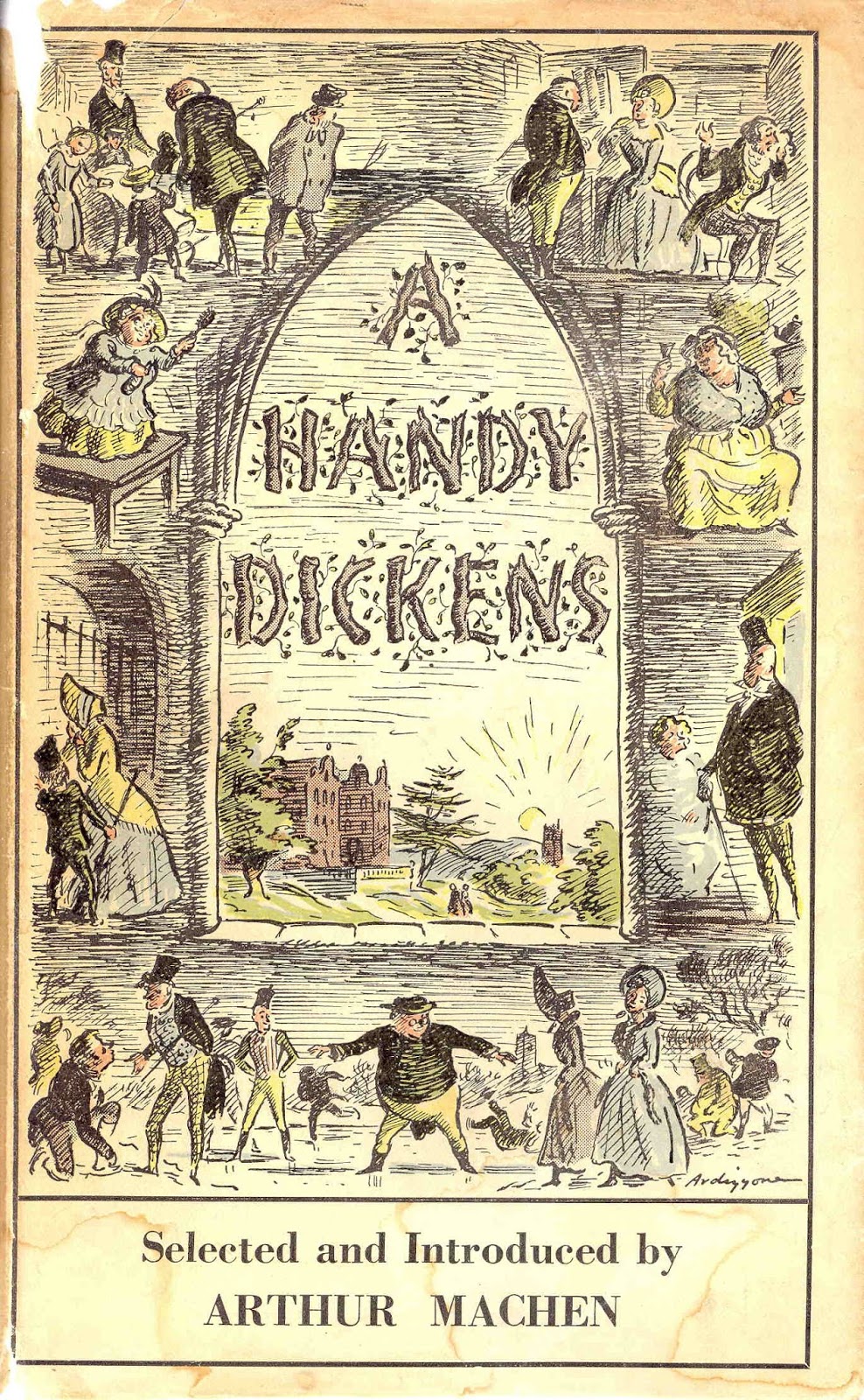
I don’t suppose that Machen derived the idea specifically of a moved bust of Pitt from Dickens’s novel, but I imagine that the Pitt-bust itself was placed in Machen’s mind by one or other of his readings – I imagine there were more than one – of Dombey and Son.  That Machen was a great reader of Dickens is well-known.  It’s his preface that begins A Handy Dickens.  Overt references to Dickens appear in other things by Machen, and perhaps further instances of (likely) unconscious allusions to Dickens will come to light.

A Handy Dickens (1941)