Tuesday, February 9, 2021

A Purple Thread - Nina Antonia


 A Purple Thread by Nina Antonia is an elegant prose meditation on the sense of the fateful in Oscar Wilde’s life and work. The supernatural pervades his writing and The Picture of Dorian Gray alone places him with Machen and Stevenson as a leading figure in the decadent macabre. 

But there is also often a particular fascination with the idea of destiny, even if it is sometimes at first treated flippantly, as in the palmistry reading in Lord Arthur Savile’s Crime, which the title character feels he must fulfill.

In a blog post on her publication, Nina explains that it was inspired in part by an often-unregarded memoir, Aspects of Wilde (1936) by Vincent O’Sullivan, and comments: ‘One paragraph in particular, where the author notes that Aubrey Beardsley was amongst many who believed that to own any of Oscar’s books was unlucky, stayed with me, just as the music from a song does, playing over and over.’

And this thought prompted the theme explored in the chapbook, the sense of a tragic doom in Wilde’s career, which is reflected also as a preoccupation in his fiction and drama.

The chapbook is characterfully illustrated by Nathaniel Winter-Hébert and is a special publication of the Fiddler’s Green imprint, whose by-line is ‘Art & Magic for Tea-Drinking Anarchists, Convivial Conjurors & Closeted Optimists.’ 


Friday, February 5, 2021

Some Notes on Some Recent Books

Here are some recent, and less-recent, books I'd like to call attention to. This column has been rather delayed, for various reasons, and I haven't had the chance to read some of these titles yet, much though I'd like to.

First, early on in Covid times, David and Daniel Ritter released The Visual History of Science Fiction Fandom, Volume One: The 1930s. This came out as a lavish (and expensive) hardcover, since reprinted, but also as an affordable Kindle ebook. I can't say enough of praise for this book, so will recommend a visit to the publisher's webpage here, where you can also click on a digital sampler of some 52 pages from the book. What a picture of fandom in the 1930s!

Next up, is David Tibet's latest anthology, There Is A Graveyard That Dwells in Man (Strange Attractor Press), a follow-up to his 2016 anthology (from the same publisher) The Moons at Your Door. Good and eclectic selections in both.  See the publishers webpage here, and here.
 
The third and fourth volumes of Jean Ray's horror tales, translated by Scott Nicolay, have come out in the Wakefield Press series.  I don't know how many more volumes are planned, but I hope there might be several more. The third is The Great Nocturnal, containing 5 tales; and the fourth is Circles of Dread, with nine stories. 

Snuggly Books has published the second volume (of two) of fiction by Montague Summers, The Bride of Christ and Other Fictions, including eight stories, all but one of which are newly published. Introduction by Daniel Corrick. 

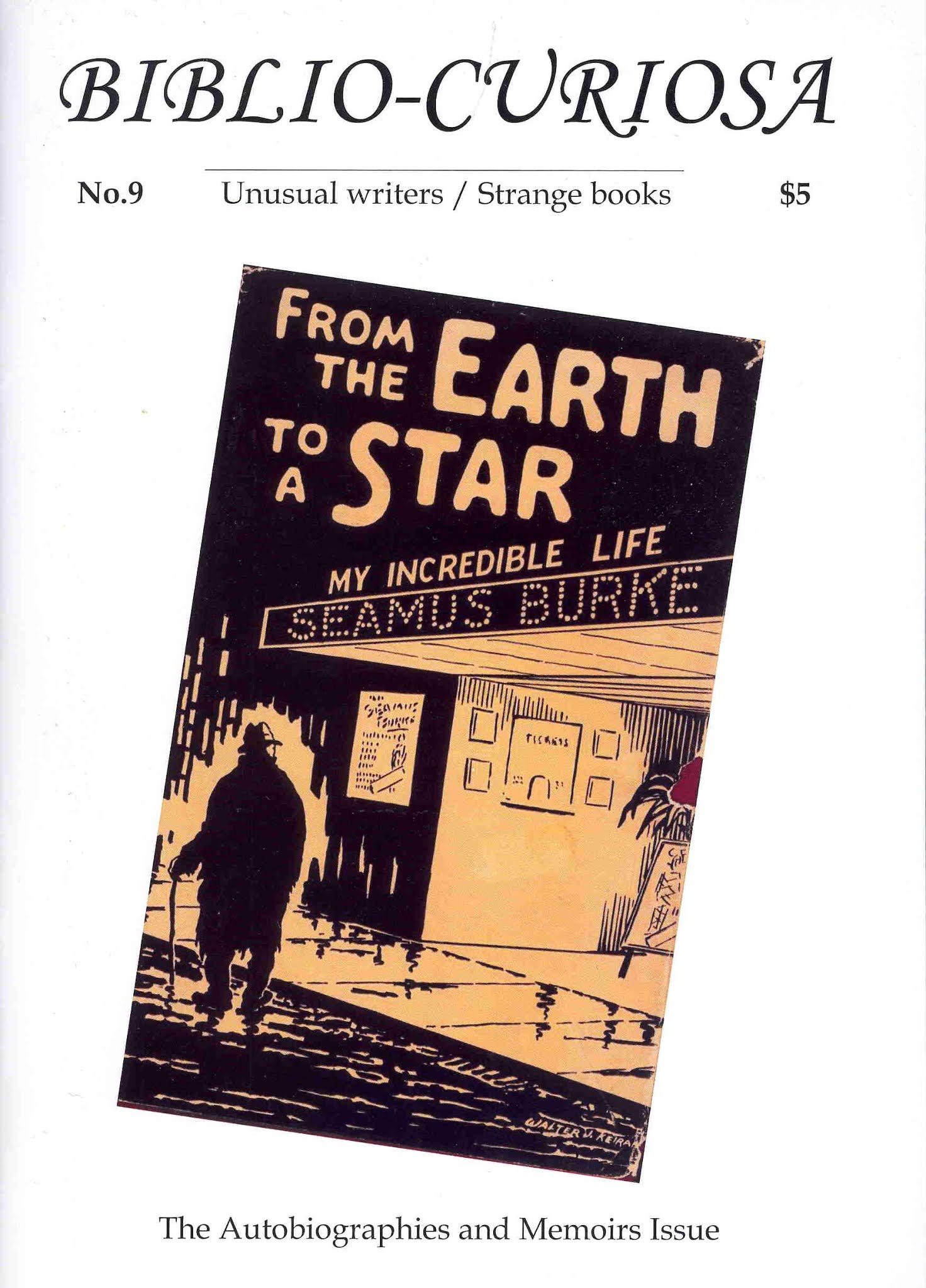
On the magazine front, there was a new issue of Chris Mikul's Biblio-Curiosa, on unusual writers and strange books. Issue 9 is "The Autobiographies and Memoirs Issue" and covers E.W. Martell, Seamus Burke, Mary MacLane, G.  Gordon Liddy, and Crook Frightfulness by A Victim, and a review of a recent autobiography by Sir Edmund Backhouse.  Inquiries to the author/publisher chris<dot>mikul88<at>gmail<dot>com. 

 And there was a new issue of Le Visage Vert (no. 31), with stories by Arthur Machen, Maurice Renard, Mark Valentine, Camille Mauclair, Pascal Malosse, Pascal Mulot, and Sophus Bauditz. For a contents listing see here. There is also a companion volume of stories by Maurice Renard, Celui qui n'a pas tué, edited and with a preface and bibliography by Claude Deméocq. Ordering information for both books (and many others) can be found by scrolling around here. 


And finally, Tartarus Press publisher R.B. Russell collected his own bookish essays, a handful of which first appeared here on Wormwoodiana, in Past Lives of Old Books and Other Essays. It first came out in hardcover, but is now also available as a trade paperback and an ebook.  Details here.


Monday, February 1, 2021

I'll Tell You Everything

I’ll Tell You Everything, A Frolic by J B Priestley and Gerald Bullett (1933) is a story-telling romp in the style of Robert Louis Stevenson’s New Arabian Nights, G K Chesterton’s The Club of Queer Trades or Arthur Machen’s The Three Impostors (though not nearly so macabre as that). That is to say, a sequence of connecting episodes, extravagant, more or less unreliable, with a final explication that just about holds things together.

A young Cambridge academic, an expert on Dark Age history and the decline of the Byzantine Empire, happens to share his train compartment with an Italian gentleman, who asks him to hide a steel casket. It is wanted by some ugly customers who may be lying in wait for him at the terminus. He explains it holds the relics of the Prophet Yann (a Dunsany-ish name) which have the power to ignite the whole of Central Asia.

The casket is then pursued through numerous bewildering adventures, in which further, different explanations of its ‘true’ import are given, often starting with the supposedly frank phrase of the book’s title. There are disguises, pursuits, practical jokes, sleights of hand, deceits, shadowy characters and more.

If the destination doesn’t quite live up to the fantastic parade leading up to it, nevertheless the reader has had a lot of colourful, quick-witted, light-hearted yarn-spinning en route. And there is a nicely artful coda too, which exhibits that these two stalwart authors were up to the tricks and twists of post-modernism years before.

The novel is similar in style and tone, though even better than, J B Priestley’s first novel, Adam in Moonshine (1927), about a Jacobite conspiracy in the wilds of Yorkshire, and it prefigures Bullett’s two picturesque detective novels under the name Sebastian Fox, One Man’s Poison (1956) and Odd Woman Out (1958), both well worth reading too.

What comes across most of all from the book is the sheer gusto of the yarn-spinning. I don’t know how the collaboration worked, but I several times wondered if each author had written alternate chapters, and had contrived to set up the most improbable scenario possible for their colleague to unravel, in a wild and hilarious friendly rivalry. In any case, this is an entertaining, picturesque tale told with accomplished skill and great enthusiasm.

(Mark Valentine)

Image: The Passing Tramp blog. 


Friday, January 29, 2021

The Real "Francis Stevens"

The internet, as usual, perpetuates a lot of errors, and makes up its own new ones. With the writer "Francis Stevens" one hardly knows where to begin correcting the errors.  First, there is her name.  She was born "Gertrude M. Barrows" (the M. is sometimes claimed to have been Mabel, but this is unconfirmed, as the state of Minnesota, and the county in which she was born, do not have birth records going back that far; yet in the 1895 Minnesota Census she appears with her family as "Myrtle"--which would seemingly be her middle-name, as she was perhaps known familiarly). Her first published story in 1904 was signed "G.M. Barrows."  She married in 1908, a man surnamed Bennett who died in 1910. She published all of the rest of her stories between 1917 and 1923, under the byline "Francis Stevens."  During this time she was known as Gertrude Bennett. A decade after she ceased writing, she married a man surnamed Gaster, and was known as Gertrude Gaster for the rest of her life (she died in 1948).  But the internet has renamed her "Gertrude Barrows Bennett." not a form of her name that she used. Similarly, modernity knows Poe as "Edgar Allan Poe"--not by the name "Edgar A. Poe" with which he signed his writings. 

Barrows's birthyear is also mistakenly given as 1884, the year she herself gave out in later life.  But early census records make it clear she was born in 1883.  

And currently, there is a a supposed photograph of her that comes up when you search google for "Gertrude Barrows Bennett."  Only it's not her.  

Here is the erroneous photograph.  The earliest appearance of it I can find on the web comes from 2018 in a twitter post here (the twitter thread contains other poppycock).

 Not "Francis Stevens"

Here is the writer "Francis Stevens"--in detail from a 1927 photograph, one of the few of her that passed on to her grandchildren.

The real "Francis Stevens" in 1927
And the mistaken "facts" continue on from there.