
Fernyhough’s Library, c. 1920
I am a book collector, which is why I mainly wrote about bookshops and booksellers in my memoir, Fifty Forgotten Books. A recent acquisition, however, has made me think again about the libraries that have also influenced my reading and researches. I mentioned a few in Fifty Forgotten Books, the first being the library in the semi-basement at the Horam Clubrooms in Sussex. It must have closed at some time in the mid 1980s, and although it was half underground I remember it as a warm, friendly, cramped space that smelt of furniture polish.
It offered unexpected adventures in books I’d never heard of, and for a few years my sisters and I used its services in the summer holidays. Horam Library was an outlier of the county library system, but it felt as though it was a part of the village. It was not the sort of ‘hub’ that libraries strive to be these days, but there was a shared community among those who borrowed and read the books. My grandparents also used it, and I wondered who else had read the books I chose, assuming they were near-neighbours when, in fact, the books were circulated around the whole of East Sussex.
At the other end of the spectrum I have great memories, dating from many years later, of my visits to the British Library in London, not least when Rosalie and I were able to discover previously unseen documents (because they had been mis-catalogued) in the Robert Aickman archive. It has been my great pleasure to help facilitate accessions into the British Library of unique material for both their Aickman and Machen archives.
Other libraries have been important to me, not least my library at Heathfield School, which was a part of my social life at the time. And Sheffield University Library, with its separate Architecture Library run by an ‘alternative’ character who was so disorganised that nobody ever checked books in and out officially.
I also have happy memories of the private library found down Pipe Passage in Lewes in the mid 1990s. I couldn’t afford to join, but I ended up there on occasional lunchtimes with David Jarman, joined by Peter Carter, who owned the Disjecta bookshop downstairs. I remember one baking hot summer day when we sat in the shadowy coolness of the large reading room drinking a bottle of retsina, after which I had to go back to work, and failed to get anything done.
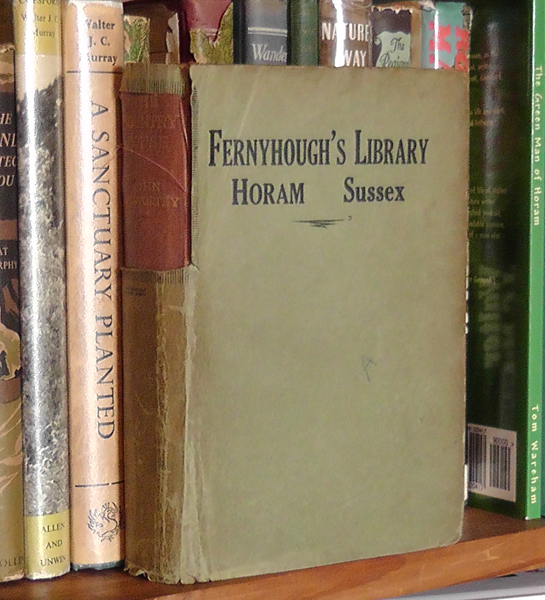
The Country House by John Galsworthy, in a Fernyhough’s dustwrapper
My recent acquisition is a book previously from Fernyhough’s Library in Horam—a private circulating library that preceded my time in the village. I don’t know when my father found this particular book, but I had seen it on his shelves without realising exactly what it was. Its title, The Country House by John Galsworthy, hadn’t appealed to me, but taking it off the shelf one day I found a dustwrapper affixed to the boards that announced it was from Fernyhough’s Library.
Private circulating libraries were popular institutions at the end of the nineteenth and the beginning of the twentieth century. Those like Fernyhough’s were found in towns and villages before county libraries opened branches in places like the basements of local clubrooms. Fernyhough’s appears in photographs dated 1910, and I knew it was in existence in 1920 when Walter Murray, who rented the derelict house which he called Copsford (in his book of the same name), would have been visiting the daughter of the house, Winifred Fernyhough. Walter and Winifred were married in 1926, and her parents were evidently still operating their library a year later, when my edition of Galsworthy’s book was published (1927—the ‘Popular 3s. 6d. edition’). A label under the jacket explains that ‘The charge for the use of this Volume is 2d. for each week kept’.
I can’t help wondering who has read this copy of The Country House by John Galsworthy? I now intend to read it myself. Unlike books from county libraries, this copy of The Country House would have circulated only within Horam. I know it may be fanciful to imagine either Walter Murray or Winifred Fernyhough reading it, but it is possible, just as it is possible that it was once read by one of my forebears, many of whom lived in and around Horam.
Through the books from old libraries a sense of community does not just have to be local. It can travel through time, down the generations.

Fernyhough’s Library, c. 1920
**updated 6 January 2026**


